What if the 80 foot Douglas fir leaning toward your roof isn’t just a landscape feature, but a complex physics problem waiting for a catalyst? It’s natural to feel a knot in your stomach when the wind picks up in Portland and you’re staring at a massive, leaning trunk near your home. You might be confused about whether a tree is simply dormant or truly dying, and the thought of a disaster creates a heavy burden of anxiety. This uncertainty, combined with the fear of property damage, makes high risk tree removal one of the most technical and stressful challenges a homeowner can face.
We understand that protecting your family and your investment requires more than just a chainsaw; it requires precision and a deep respect for the local environment. In this guide, you’ll learn how to identify the critical warning signs of a hazardous tree, such as structural instability or decay. You’ll also see how professional crane services and technical rigging allow experts to dismantle massive trees in tight spaces without risking your house. By understanding the permit requirements for trees over 12 inches in diameter and the latest safety protocols, you can move from worry to a clear, professional plan for your property.
Key Takeaways
- Identify the specific conditions, such as proximity to structures and power lines, that classify a tree as a high-risk hazard rather than just a dead or dormant specimen.
- Recognize critical structural red flags like root plate heaving and internal decay that signal a high probability of an imminent tip-over.
- Understand how professional crane services eliminate the “felling zone” danger by lifting heavy timber sections vertically away from your home.
- Learn the technical rigging and roping methods experts use to control heavy loads safely within the tight residential spaces common in Portland.
- Gain the knowledge needed to manage a high risk tree removal project without compromising the safety or aesthetics of your property.
What Defines High-Risk Tree Removal in 2026?
High risk tree removal isn’t just about cutting down a dead tree; it’s a technical designation for extractions where the probability of property damage or personal injury is exceptionally high. While many homeowners assume a tree must be rotting to be dangerous, the reality is more complex. A vibrant, green tree can be classified as high-risk if its size and location put it within striking distance of primary power junctions or structural foundations. Experts prioritize assessing tree health and risk by looking at the “target zone,” which is the specific area where a tree or its limbs would land if they failed. In Portland, any tree over 12 inches in diameter requires a permit for removal, but the high-risk label is what dictates the technical approach we take to protect your home.
Understanding the difference between a simple felling and a complex extraction is vital for safety. High risk tree removal is the intersection of tree instability and proximity to valuable assets. When we evaluate a site, we don’t just look at the wood; we look at the potential impact on your roof, your neighbors, and the local utility lines. Identifying these hazards early allows for a controlled extraction that prevents structural damage and avoids the steep civil penalties for unlawful removals. Our team treats every project as a precision engineering challenge where safety is the only metric of success.
Common High-Risk Scenarios for Portland Homeowners
Portland’s unique landscape and weather patterns create specific challenges for property owners. Our teams frequently encounter these high-stakes situations that require specialized intervention:
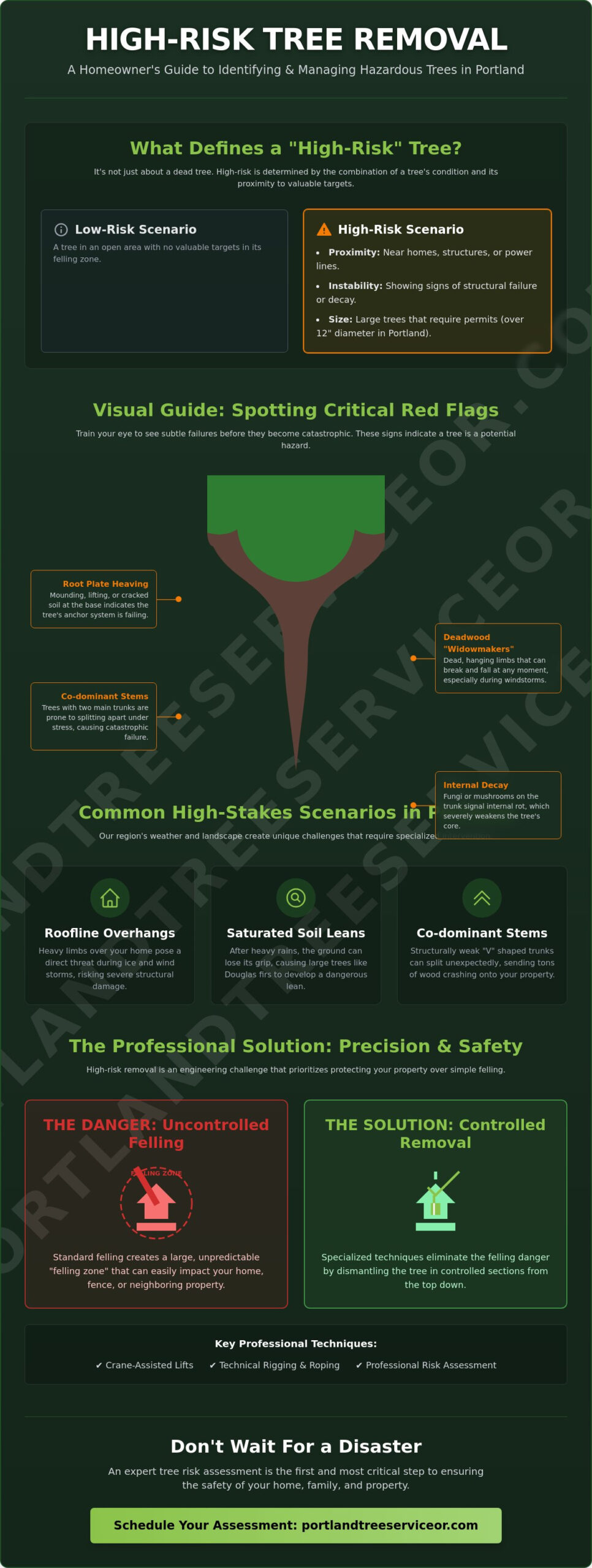
- Roofline Overhangs: Heavy limbs extending over primary structures or power junctions create a constant threat during ice or wind events. Removing these limbs with precision rigging prevents them from crashing through shingles or disrupting your electricity.
- Saturated Soil Leans: After heavy rains, large species like Douglas firs can develop a significant lean as the ground loses its grip on the root plate. Securing these trees quickly stops them from uprooting entirely during the next storm.
- Co-dominant Stems: Trees with two main trunks splitting at the base are prone to catastrophic failure. Using professional equipment to manage these structural splits protects your property from the sudden impact of a falling trunk.
Identifying Hazardous Trees: Red Flags and Structural Failures
Spotting a hazardous tree requires a keen eye for subtle structural failures that often go unnoticed by the untrained eye. Root plate heaving is a primary indicator of an imminent tip-over. If you see soil lifting, mounding, or cracking at the base of a trunk, the tree’s anchoring system is actively failing. Internal decay often hides behind healthy-looking bark, but you can spot it by looking for mushrooms or “fruiting bodies” growing on the wood. These fungi signal heartwood rot, which significantly weakens the tree’s core. The U.S. Forest Service provides detailed guidance on Hazard-Tree Identification and Mitigation for our specific region.
Distinguishing between a natural lean and an active failure is another critical skill for property owners. Many trees exhibit “corrective growth,” where the trunk curves upward like a “pistol butt” to compensate for a past lean. This is usually a sign of a stabilized tree. However, a straight lean accompanied by cracked soil or exposed roots suggests the tree is currently shifting. During Portland windstorms, deadwood and hanging limbs, often called “widowmakers,” become immediate overhead hazards that necessitate high risk tree removal to protect your home and family.
The Role of Professional Tree Risk Assessment
Visual inspections are a good starting point, but they don’t tell the whole story of a tree’s internal integrity. A professional tree risk assessment is the first step in high risk tree removal, as it uses technical methods to identify hollow trunks or hidden root decay. Early detection is the best way to ensure safety while avoiding the high costs and stress associated with an emergency tree service after a failure occurs.
Weather-Induced Risks in the Pacific Northwest
Our Pacific Northwest weather adds unique stressors to the local canopy that can turn a stable tree into a hazard overnight. Ice storms significantly increase the “sail area” and total weight of evergreen branches, causing them to snap or shatter under the load. In hillside neighborhoods across Lake Oswego and West Linn, heavy winter rains saturate the soil. This saturation softens the ground, making tall Douglas firs more likely to topple when the wind picks up because the roots can no longer grip the muddy earth. Homeowners in these communities should familiarize themselves with local regulations, as understanding the specifics of West Linn tree removal permits and species requirements is essential before addressing any hazardous tree on your property.
Technical Solutions for Complex Extractions
Executing a high risk tree removal requires more than just physical strength; it demands a deep understanding of structural engineering and physics. While traditional methods rely on gravity to fell a tree, technical extractions in tight residential spaces often require us to bypass gravity entirely. By utilizing crane services, we lift timber sections vertically. This process eliminates the traditional felling zone, ensuring that heavy branches never have the chance to impact your roof or landscaping. Our approach to Managing tree hazards and risks involves a combination of precision rigging and roping to control every pound of weight as it moves through the air.
Safety is our baseline, not an afterthought. We strictly adhere to ANSI Z133 safety requirements, which govern the specialized equipment and maneuvers used in the tree care industry. To protect your property further, we use low-impact equipment like specialized ground mats and high-capacity cranes. These tools allow us to operate in manicured Lake Oswego backyards without leaving ruts in the turf or damaging expensive hardscaping. It’s a methodical process that prioritizes the integrity of your land while removing the threat overhead.
Why Specialized Cranes are the Gold Standard
Cranes are often the only viable solution when a tree has become too structurally unstable for a climber to ascend safely. Utilizing a professional crane tree removal service allows our team to dismantle a hazard from the top down without putting weight on the failing trunk. This method provides the ultimate level of protection for fences, ornamental gardens, and neighboring properties by keeping all debris contained within a controlled vertical corridor.
Commercial and Large-Scale High-Risk Management
Managing hazards at scale requires a different level of logistical planning and liability oversight. We provide commercial tree removal in Portland for apartment complexes, HOAs, and corporate campuses where public safety is a primary concern. For property managers, addressing high-risk trees is a critical step in liability protection. Identifying these hazards early ensures that your common areas remain safe for residents and visitors while protecting the long term value of the landscape.
Secure Your Property with Expert Intervention
Managing hazardous trees in the Pacific Northwest requires a combination of vigilant observation and technical precision. By recognizing early warning signs like root plate heaving or internal decay, you can address potential failures before the next major windstorm arrives. Modern extractions rely on specialized crane equipment to lift timber vertically; this process protects your home and landscaping from the impact of traditional felling methods. Proactive identification ensures that your canopy remains an asset rather than a liability.
When you face a complex situation, you need a partner with the right tools and the local expertise to handle it safely. We are locally owned and operated in Portland, OR, with over 30 years of experience in high risk tree removal across the region. Our team utilizes specialized cranes for zero-impact removals that ensure your property remains pristine throughout the process. Don’t let a leaning fir or a cracked trunk become a crisis for your household. Request a High-Risk Tree Assessment from Portland Tree Service today to gain peace of mind and protect your investment.
Frequently Asked Questions
How do I know if a tree is high risk or just needs pruning?
A tree is considered high-risk when it shows signs of structural failure that could cause it to fall on a target, such as your home or a power line. Pruning typically addresses aesthetic shaping or the removal of small, dead branches to improve tree health. In contrast, high-risk indicators include deep vertical cracks in the trunk, soil mounding at the base, or a sudden change in lean. If the tree’s failure would result in property damage, it requires a professional evaluation rather than a simple trim.
Can I remove a high-risk tree myself if I have a chainsaw?
You should never attempt a high risk tree removal as a do it yourself project because the physics of a failing tree are unpredictable. Professional crews use specialized rigging, high-capacity cranes, and aerial lifts to control the descent of heavy timber in tight residential spaces. Without this equipment and the training required by ANSI Z133 safety standards, you risk catastrophic injury or severe damage to your home. It’s always safer to rely on experienced veterans who have the technical tools to manage the weight and balance of the tree.
What should I do if a neighbor’s high-risk tree is leaning toward my house?
Your first step should be to have a calm, professional conversation with your neighbor to express your concerns about the tree’s stability. In Portland, property owners are responsible for the maintenance and safety of the trees on their land. If the tree is clearly hazardous, you might suggest a joint professional assessment to document the risk. Having a certified report can help clarify the situation and encourage the neighbor to take action before a storm causes the tree to fail.
How much does a high-risk tree removal cost compared to a standard one?
High-risk removals generally involve a higher investment than standard removals due to the increased complexity and specialized machinery required. A standard removal often involves felling a tree in an open space, but high-risk projects frequently require crane services to lift sections over rooflines. The additional labor, technical rigging, and insurance requirements for hazardous work contribute to the total. While the upfront cost is higher, it’s significantly less expensive than repairing structural damage to your home after a tree fall.
Does insurance cover the removal of a hazardous tree before it falls?
Most homeowner insurance policies do not cover the preventative removal of a hazardous tree, as they view this as a standard property maintenance responsibility. Insurance is designed to cover “sudden and accidental” damage that occurs after a tree has already fallen on a covered structure. While it’s frustrating to pay for the removal out of pocket, addressing the hazard now prevents the much larger headache of an insurance claim and the potential displacement from your home after a disaster.
What happens if a high-risk tree is near power lines?
Trees near high-voltage power lines are exceptionally dangerous and require coordination with local utility companies. You should never touch or attempt to cut a tree that is in contact with or within close proximity to primary electrical wires. Professionals often work alongside utility crews to ensure the lines are de-energized or shielded during the extraction process. This specialized coordination protects the workers and prevents widespread power outages in your Portland neighborhood during the removal.