What if that towering Douglas fir in your backyard isn’t just dormant for the season, but is actually a structural liability waiting for the next 60 mph gust? Most Portland homeowners value our city’s 29.8% canopy coverage, yet they live in fear of the next major windstorm. It’s difficult to tell the difference between a tree that’s naturally shedding and one that’s a genuine hazard. You shouldn’t have to guess whether your home is at risk or feel pressured by companies that suggest removing every tree they see. Understanding a professional tree risk assessment is the first step toward peace of mind.
This guide will teach you how to identify hazardous trees and understand the professional assessment process to ensure your home stays safe during Oregon’s windstorms. We’ll break down the specific red flags our master climbers look for, such as root decay and hazardous limbs, while explaining the diagnostic tools used to evaluate tree health. You’ll also learn about Portland’s updated 2026 tree codes and how to navigate the permitting process to avoid the city’s steep penalties for unauthorized removals. We’ll show you how a safety-first approach protects your property without sacrificing the trees that make our community beautiful.
Key Takeaways
- A professional tree risk assessment provides a systematic evaluation of a tree’s structural integrity and identifies potential “targets” like your home or power lines.
- Learn to spot seven critical warning signs of structural compromise, including how fungal growth like mushrooms can signal hidden internal decay.
- Discover why a high-risk finding doesn’t always require a full removal; many trees can be stabilized through expert cabling or precision pruning.
- Understand the hierarchy of safety solutions to ensure you receive reputable advice that prioritizes both property protection and the health of the Portland canopy.
What is a Tree Risk Assessment and Why Does It Matter in Portland?
A tree risk assessment is a systematic, objective process used to evaluate a tree’s structural integrity and its potential to cause damage. It’s more than a quick glance at the leaves. We analyze the tree’s health and its surroundings to determine the likelihood of failure. In Portland, our wet winters and heavy clay soils create a unique environment. Even healthy-looking trees can become unstable as the ground saturates and loses its grip on the root system. A tree is only considered high-risk if there’s a “target” nearby. This means a person, a vehicle, or a structure like your home must be within the striking zone for a hazard to exist. Understanding Tree health basics helps homeowners identify when they need a certified arborist to assign a formal safety score.
The Difference Between a Visual Inspection and an Advanced Assessment
We categorize inspections into three distinct levels based on the depth of the investigation. A Level 1 assessment is a limited visual check, often used to identify obvious hazards from a distance. Level 2 is the standard for most residential properties; it involves a 360-degree ground-level inspection of the trunk, root flare, and canopy. For complex cases, a Level 3 assessment involves advanced testing. This might include using specialized tools or an aerial inspection performed by a Master Climber to check for internal decay that isn’t visible from the ground.
Species-Specific Risks for Portland Homeowners
Portland’s canopy is unique, and different species present specific challenges. Douglas firs are prone to root rot and can become top-heavy, making them vulnerable during high-wind events. Western Red Cedars often develop split trunks or internal hollows that require early detection. Bigleaf Maples, especially old-growth specimens, frequently develop hazardous limbs or structural weaknesses where the branches meet the trunk. Our 30+ years of experience in the PNW helps us spot these local nuances before they lead to an emergency. A professional tree risk assessment ensures these specific vulnerabilities are identified before the next storm hits.
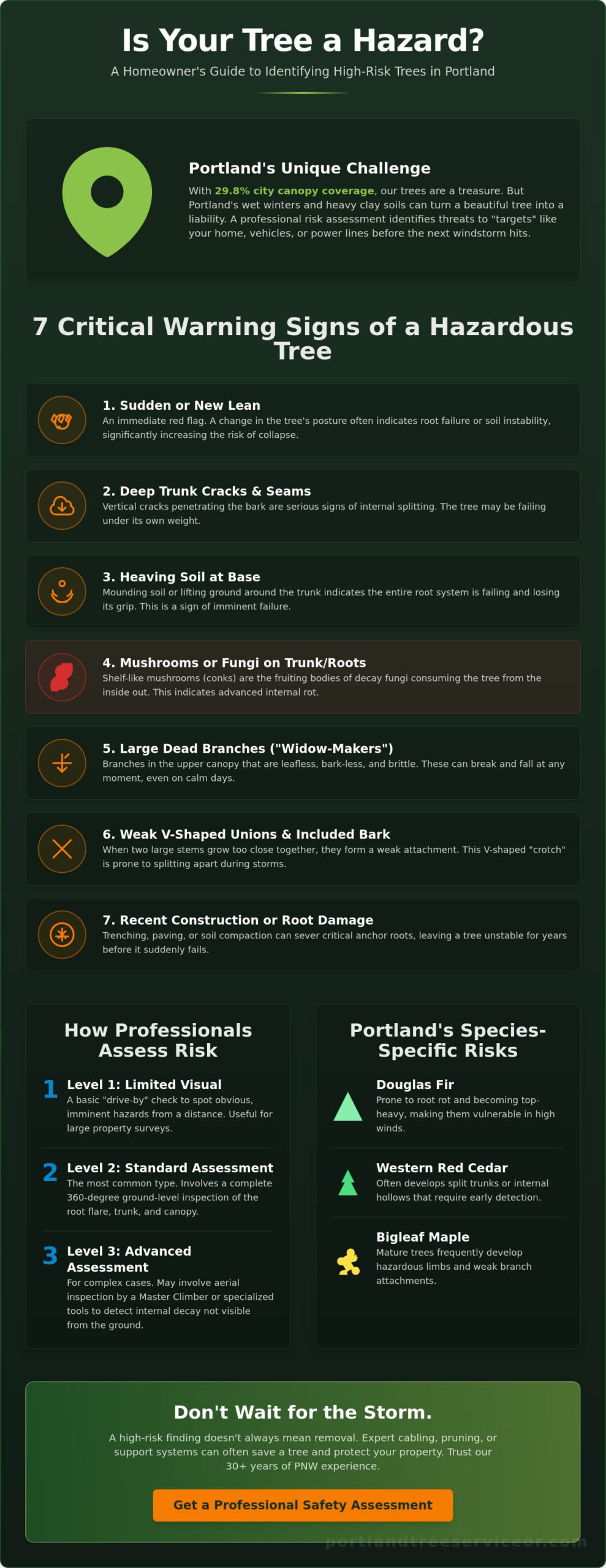
7 Critical Warning Signs: When Your Tree Needs an Immediate Safety Check
Identifying structural failure before it happens is the primary goal of a professional tree risk assessment. Property owners have a legal responsibility to monitor their trees for obvious defects. As noted by the Purdue Extension on Tree Risk, a systematic inspection helps determine if a tree poses an unreasonable threat to people or property. If you notice a tree leaning towards house structures on your property, it’s an immediate red flag. A new lean often indicates root failure or soil instability. This requires prompt attention from a certified arborist to prevent a total collapse.
Trunk and Canopy Red Flags
Look for deep vertical cracks or seams in the main trunk. These often indicate the wood is splitting internally. We also watch for V-shaped crotches, known as included bark. This occurs when two large stems grow too close together and slowly push each other apart. This creates a weak point that can fail during an Oregon windstorm. Large dead branches, often called “widow-makers,” are another high-priority concern. These limbs can fall even on a calm day once decay has set in.
- Deep trunk cracks: Vertical seams that suggest internal splitting.
- V-shaped unions: Weak attachments where stems push apart over time.
- Dead wood: Large branches in the upper canopy that lack bark or leaves.
The Root Zone: Identifying Hidden Dangers Below Ground
Signs of trouble aren’t always in the air. Heaving soil or mounding at the base suggests the root system is lifting out of the ground. If you see shelf-like mushrooms, also called conks, growing on the trunk or roots, it’s a sign of advanced internal decay. These fungi consume the structural lignin that keeps the tree upright. Construction damage is another major factor. If a driveway was recently installed near a mature tree, severed roots can leave it structurally compromised. Maintaining proper drainage is equally important for soil stability; for help with exterior maintenance, Snugs Services offers expert guidance on gutter and downspout management to protect your landscape.
Don’t confuse aesthetic flaws with genuine hazards. A few dead twigs or peeling bark on certain species might be normal. However, a professional tree risk assessment can distinguish between a minor health issue and a structural defect that threatens your home. Catching these signs early saves property and preserves the life of the tree. Our master climbers have spent 30+ years identifying these subtle markers to keep local families safe.
From Assessment to Action: Mitigation and Safety Solutions
A tree risk assessment isn’t a death sentence for your canopy. It’s a diagnostic tool that helps us find the most responsible path forward for your property. Our goal is to balance the safety of your home with the health of the local urban forest. We follow the USDA field guide for hazard tree assessment to ensure our recommendations are grounded in proven PNW forestry science. This systematic approach allows us to determine if a tree can be saved through targeted intervention or if it requires a more permanent solution.
Mitigation Options to Save Your Tree
Many structural issues can be corrected without losing the tree entirely. Structural pruning is a highly effective method where we selectively remove branches to reduce the weight and wind resistance of the canopy. This allows the tree to withstand heavy gusts during Oregon’s windstorms without snapping. For trees with weak branch unions, cabling and bracing provide essential mechanical support. These high-strength steel cables act as a safety net, holding the crown together and preventing hazardous limbs from failing over your roof or power lines.
- Structural Pruning: Reducing canopy density to lower wind load and weight.
- Weight Reduction: Trimming heavy limbs that hang over sensitive structures.
- Cabling and Bracing: Installing hardware to support weak V-shaped crotches.
When Removal is the Only Safe Path
Sometimes, the risk is too high to ignore. If a tree is dead, has a non-correctable lean, or shows signs of massive internal decay, removal becomes the only safe option. In tight residential areas like Lake Oswego or West Linn, this requires a high level of precision. We utilize specialized crane tree removal service to lift large sections of the tree over your home or landscaping. This prevents the impact damage often associated with traditional felling methods. Our Master Climbers handle these high-risk removals with superior workmanship. They ensure the job is done safely and efficiently, even in the most cramped Portland backyards.
Trusting a local company with 30+ years of experience means you get an honest, professional evaluation. We don’t suggest removal for every tree we inspect. Instead, we provide a definitive solution that prioritizes your safety and the longevity of your landscape. Whether your property needs a simple prune or a complex crane tree removal service for hazardous trees, we execute every plan with the methodical care you expect from a neighborhood veteran.
Secure Your Property Before the Next Storm
Proactive care is the best defense against the unpredictable nature of Oregon’s weather. By recognizing the critical warning signs of structural failure and understanding the mitigation options available, you take control of your property’s safety. A professional tree risk assessment provides the objective data you need to make informed decisions about your landscape. Whether your trees require precision pruning to reduce wind resistance or a complex removal, having an expert evaluation ensures you aren’t leaving your home’s protection to chance.
We’ve spent 30+ years serving the Portland community with reliable, safety-focused solutions. Our team includes a Master Climber and utilizes specialized crane equipment to handle even the most hazardous removals in tight residential spaces. You don’t have to face the next windstorm with uncertainty. Schedule your professional tree risk assessment with Portland Tree Service today to ensure your canopy remains an asset rather than a liability. We take pride in our superior workmanship and look forward to helping you maintain a beautiful, safe property for years to come.
Frequently Asked Questions
How much does a professional tree risk assessment cost in Portland?
A basic professional evaluation in the Portland area typically ranges from $75 to $150 for a single tree. More comprehensive inspections with written reports or Level 2 assessments using TRAQ methodology can cost between $300 and $500. These rates vary based on the complexity of the site and the number of trees involved. Investing in this diagnostic tool helps you avoid the much higher costs associated with emergency storm damage.
Can I perform my own tree risk assessment?
While you can monitor your trees for red flags, a formal tree risk assessment requires professional training. Certified arborists use specialized knowledge to identify internal decay and root instability that isn’t visible to the untrained eye. Homeowner observations are helpful for early detection, but a professional evaluation provides the objective safety score needed for insurance purposes and city permitting compliance. Our 30+ years of experience ensures every hazard is identified.
Is a leaning tree always a sign of imminent danger?
A leaning tree isn’t always an immediate threat, but it always requires a professional look. Some trees grow with a natural lean to reach sunlight, which is generally stable. However, if a tree leaning towards house structures suddenly develops a more pronounced tilt or if you notice mounding soil at the base, the root system is likely failing. We evaluate the target area to determine if the lean poses a genuine risk to your home or power lines.
Does my homeowners insurance cover a tree risk assessment?
Most homeowners insurance policies don’t cover the cost of a preventative tree risk assessment. These inspections are considered part of routine property maintenance. However, many insurance companies do cover the removal of a tree if it falls and damages a covered structure during a storm. Proactively identifying hazards can help you maintain your coverage by proving you’ve exercised your duty to inspect and maintain a safe property.
What happens if my tree is found to be hazardous after a storm?
If a tree is deemed hazardous following a major windstorm, immediate mitigation is necessary. We often deploy crane services to safely remove unstable trees that are leaning toward structures or have hanging limbs. Depending on the severity of the damage, we might suggest emergency removal or structural pruning to stabilize the canopy. Our goal is to secure your property promptly while adhering to Portland’s regulatory requirements for dangerous trees.
How often should I have the trees on my property inspected?
We recommend a professional inspection every three to five years for healthy, mature trees. However, you should schedule a checkup immediately following severe weather events or if you notice new structural changes. Regular evaluations are especially important for large species like Douglas firs and Bigleaf Maples, which are common in our local landscape. Consistent monitoring allows us to catch internal rot or root issues before they become high-risk liabilities.