Imagine a 100-foot Douglas Fir leaning precariously over your roof during a classic Oregon windstorm. In the narrow lots of our local neighborhoods, the traditional method of felling a tree isn’t just risky; it’s often physically impossible without causing major property damage. You’re likely worried about heavy tires rutting your lawn or the headache of navigating city hall. It’s a common concern, especially since any tree over 12 inches in diameter on private property requires a formal permit from the city.
When you’re facing the challenge of large tree removal Portland requires a level of precision that only specialized crane services can provide. We’ve spent decades perfecting these high-stakes extractions to ensure your home stays safe and your landscape remains untouched. In this case study, you’ll discover why crane-assisted removal is the most efficient way to handle hazardous trees in tight spaces. We’ll show you how our veteran team uses specialized equipment to lift massive sections of wood clear over your house, and we’ll explain how the 2025 permit fee eliminations make this process easier than ever.
Key Takeaways
- Understand why Portland’s unique landscape and narrow property lines make traditional tree felling a significant liability for homeowners.
- Learn how precision crane technology allows for safe large tree removal Portland properties require when dealing with massive 100-foot specimens in tight spaces.
- Explore the critical pre-operation phases, including site assessment and utility coordination, that prevent property damage during high-risk extractions.
- Discover why hiring an ISA Certified Arborist is essential for managing the technical complexities and safety protocols of large-scale tree projects.
- See how choosing a provider that owns and operates their own specialized equipment ensures a more controlled, reliable, and damage-free removal process.
The Challenge of Large Tree Removal in Portland’s Urban Canopy
Portland’s dense urban canopy is a point of pride, but it presents unique dangers for homeowners in older neighborhoods. Many properties in areas like Laurelhurst or Sellwood feature massive specimens towering over homes built just feet apart. When you’re managing a 100-foot Douglas fir or a Western red cedar, the margin for error is nonexistent. These species are prone to specific failures; Douglas firs act as massive sails in windstorms, while Bigleaf maples often suffer from internal rot that weakens heavy limbs. Identifying a high-risk tree involves looking for deep trunk cavities, fungal growth at the base, or a sudden lean toward your roof. High-Risk Tree Removal is a specialized operation requiring advanced rigging and heavy machinery to safely extract hazardous wood from confined spaces.
Why Traditional Climbing Isn’t Always Enough
For decades, the standard for Arboriculture was a climber with a chainsaw and a rope. In the tight quarters of Lake Oswego or West Linn, this “roping and rigging” method often reaches its physical limit. There is simply no safe place to drop or swing heavy wood. Manually lowering several tons of timber piece-by-piece creates immense physical fatigue for ground crews. This exhaustion increases the risk of human error, which can lead to catastrophic property damage. When we perform large tree removal Portland residents trust, we prioritize mechanical advantage. Using a crane allows us to lift sections vertically, removing the “swing” factor entirely and protecting your home’s siding and gutters.
The Environmental Impact of Large Tree Loss
Removing a mature tree affects more than just your skyline. These giants are the primary defense against local soil erosion and stormwater runoff in the Pacific Northwest. Under the 2026 Portland Tree Code, property owners must navigate specific mitigation and replanting requirements to maintain the city’s canopy goals. While the removal of a hazardous tree is often necessary for safety, it’s vital to understand how the loss of that root system changes your property’s drainage. We provide a steady, organized approach to these transitions, ensuring your land remains stable and compliant with city regulations after the heavy equipment leaves.
Case Study: Precision Crane Removal of a Hazardous Douglas Fir
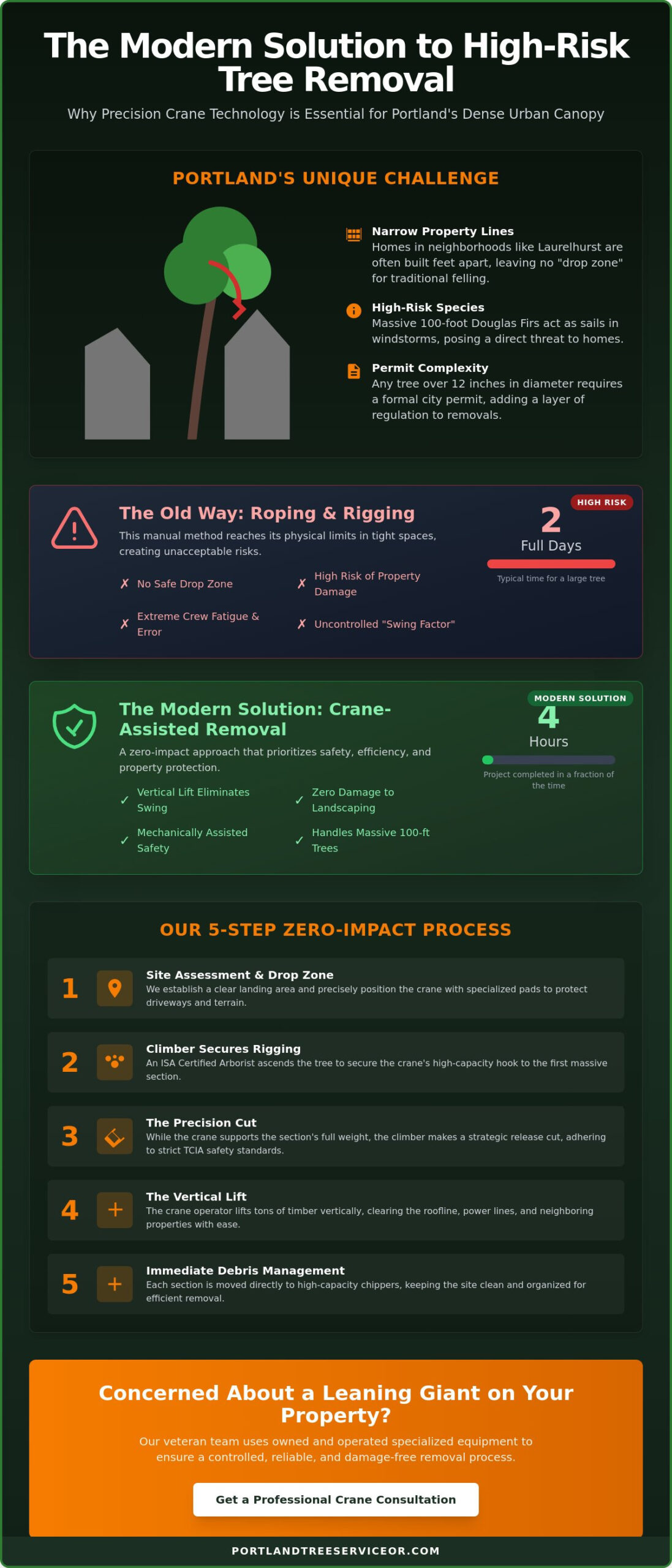
In early 2026, we managed a high-stakes project involving a 100-foot Douglas fir that had begun to lean precariously between two closely spaced homes. Standard felling wasn’t an option due to the lack of a traditional drop zone. Our pre-operation phase involved a rigorous site assessment and coordination with local utility providers to manage nearby overhead lines. We positioned our crane with surgical precision, utilizing specialized pads to distribute weight and protect the client’s driveway from the pressure of the outriggers. Crane-assisted removals aim for a zero-impact result where the tree is lifted vertically to prevent any contact with the surrounding structures or delicate landscaping.
The 5-Step Crane Removal Process
- 1. Establishing the Drop Zone: We designate a clear landing area and set crane outriggers for maximum stability on the specific terrain.
- 2. The Climber’s Role: Our veteran climber ascends the canopy to secure the crane’s high-capacity hook to the first heavy section.
- 3. The Cut: Following the rigorous safety standards of the Tree Care Industry Association (TCIA), the climber executes a precision release cut while the crane holds the section’s full weight.
- 4. The Lift: The operator lifts the timber vertically, clearing the roofline and neighbors’ fences with ease.
- 5. Debris Management: Each section moves directly to our high-capacity chippers for immediate processing and removal.
Results: Efficiency and Protection
This method saved the homeowner significant time and stress. A traditional crew using roping and rigging would’ve required two full days to dismantle a tree of this scale. By utilizing a crane, we completed the entire large tree removal Portland project in just four hours. More importantly, we completely avoided the homeowner’s expensive ornamental garden located directly beneath the canopy. The lawn remained pristine, and the hazardous threat was neutralized before the next storm cycle. If you’re worried about a leaning giant on your property, a professional crane consultation can provide the peace of mind you need.
Choosing the Right Portland Tree Service for Large-Scale Projects
Selecting the right team for large tree removal Portland homeowners can trust involves more than just a quick search for the lowest price. For projects involving massive timber and high-risk environments, an ISA Certified Arborist is a non-negotiable requirement. These professionals possess the technical knowledge to assess structural integrity and execute complex rigging plans that protect your property. When you hire a company that owns and maintains its own crane fleet, you’re ensuring a higher level of safety and operational control. We don’t rely on third-party rentals; our veterans operate our equipment with the precision that only comes from years of working together on the same machines.
Liability is a serious concern when moving thousands of pounds of wood over a residential roofline. If a 5,000lb log makes contact with your home, you need the absolute certainty that your contractor carries comprehensive liability and workers’ compensation insurance. We prioritize transparency in our documentation, providing you with peace of mind before the first cut is made. For a professional evaluation of your property’s needs, you can contact Portland Tree Service for a free risk assessment.
Navigating 2026 Portland Tree Permits
Portland’s regulations for tree preservation are strict, particularly for specimens 12 inches or more in diameter. As of July 2025, the city eliminated the fee for Tree Removal and Replanting Permits to encourage compliance, but the application process remains mandatory. Distinguishing between “Hazardous” and “Non-Hazardous” permit tracks is vital; a hazardous designation often requires a detailed arborist report to expedite approval. Failing to secure the correct permit can result in fines of up to $1,000 per tree, per day of the violation. We handle the technical reporting to ensure your project stays within legal requirements in Portland, West Linn, and surrounding areas.
Cost vs. Value: The Real Price of Large Tree Removal
The estimate for removing a massive tree depends on several logistical factors. Height and species are primary drivers, but proximity to high-voltage power lines and the available space for crane outriggers also influence the total scope of work. While a “budget” quote from a general landscaper might seem attractive, it often lacks the specialized rigging and insurance coverage necessary for high-risk extractions. The real value lies in a damage-free process and a clean site. Choosing an expert crane tree removal service prevents the hidden costs of lawn repair, structural damage, or unfinished debris hauling that frequently follow cut-rate services.
Secure Your Property with Expert Precision
Managing hazardous timber in the Pacific Northwest is a task that leaves no room for guesswork. We’ve explored how crane-assisted technology transforms a high-risk liability into a controlled, vertical extraction. This method protects your home’s structure and preserves the delicate landscaping that makes your property unique. By understanding the 2026 permit landscape and the technical requirements of large species like Douglas firs, you’re now better prepared to make an informed decision for your land.
When it’s time for large tree removal Portland residents trust our team’s 30+ years of local experience. We provide ISA Certified Arborists on every job and utilize specialized crane-assisted techniques to ensure the highest safety standards in the industry. Don’t let a hazardous tree weigh on your mind during the next storm cycle. Professional intervention is the only way to guarantee your home stays protected while maintaining the beauty of our local canopy.
Request Your Free Crane-Assisted Tree Removal Estimate today. We’re here to provide the seasoned expertise and reliable service your property deserves.
Frequently Asked Questions
How much does large tree removal cost in Portland in 2026?
The total investment for large tree removal Portland residents pay depends on the specimen’s height, species, and proximity to surrounding structures. Technical factors like the need for crane access and the complexity of the rigging plan also influence the final scope of work. We provide a detailed on-site consultation to assess these variables and ensure you receive an accurate reflection of the specialized labor and equipment required for your property.
Do I need a permit to remove a large tree on my private property in Portland?
You must obtain a permit for the removal of any tree on private property that measures 12 inches or more in diameter at 4.5 feet above the ground. As of July 2025, the city eliminated the fee for Tree Removal and Replanting Permits to encourage homeowners to comply with local canopy regulations. While the permit fee is now $0, the application process is still mandatory and must be completed before any removal begins.
Will a crane damage my driveway or lawn during the tree removal?
We utilize specialized outrigger pads and ground protection mats to distribute the weight of the machinery and prevent damage to your hardscaping or turf. The primary advantage of using a crane is the ability to lift heavy timber vertically rather than felling it onto the ground. This “zero-impact” approach to low impact tree removal ensures that heavy logs never touch your lawn, which eliminates the ruts and soil compaction common with traditional removal methods.
How do I know if my large tree is hazardous and needs immediate removal?
Warning signs of a hazardous tree include deep trunk cavities, fungal growth at the base, or a sudden, noticeable lean toward your home. You should also watch for “deadwood” in the upper canopy or large cracks in the main trunk that suggest internal decay. If you’re concerned about a tree’s stability, an ISA Certified Arborist can perform a formal risk assessment to determine if the tree is a structural threat or a healthy landscape asset.