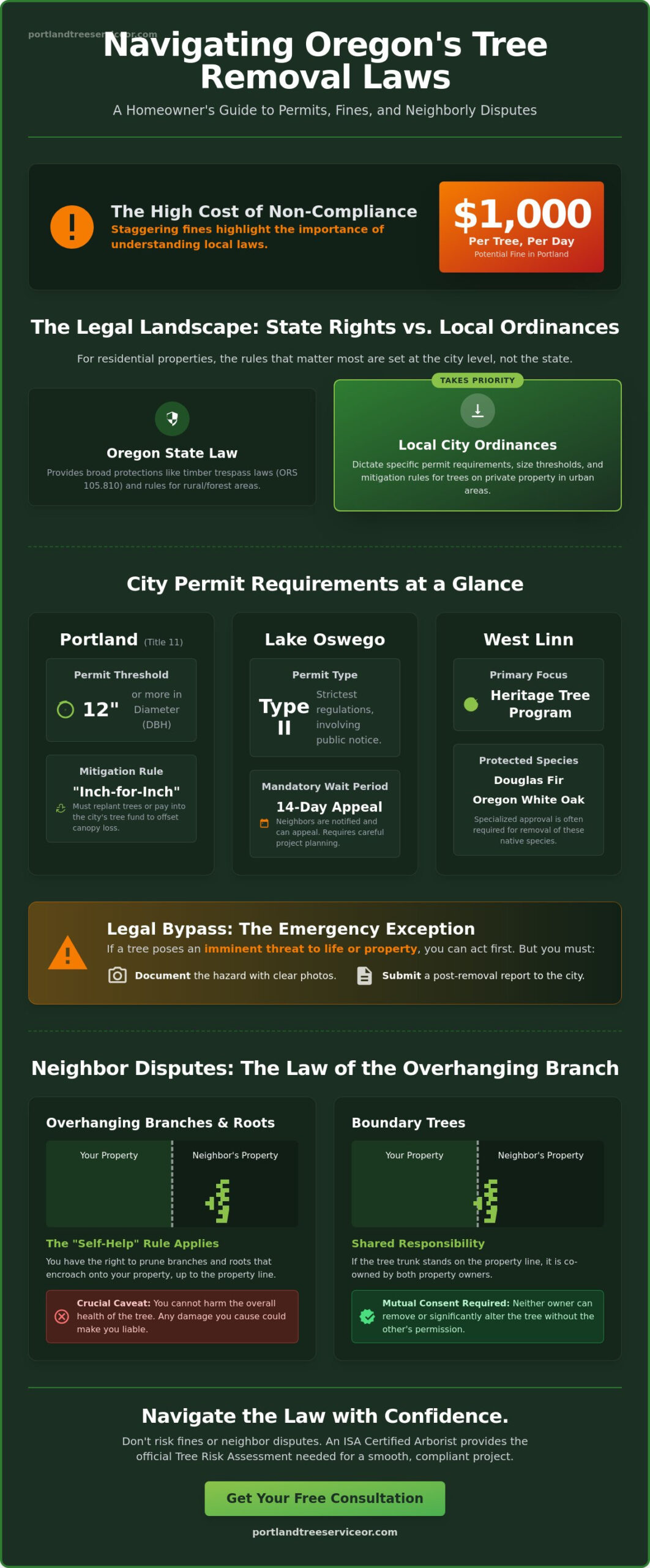
Did you know that in cities like Portland, the fine for unpermitted tree removal can reach $1,000 per tree, per day? It is a staggering figure that highlights just how seriously local municipalities take canopy protection. Most property owners want to do the right thing, but the constant shifting of Oregon tree removal laws across different counties can leave you feeling stuck between a hazardous branch and a massive city fine.
You shouldn’t have to guess whether your project is legal or if you’re overstepping onto a neighbor’s property line. We’ve spent decades working in these local landscapes, and we know that clarity is the best way to alleviate the stress of property maintenance. This guide provides the legal roadmap you need to secure the right permits, protect yourself from neighbor liability claims, and understand exactly when emergency exceptions apply to your situation.
We will examine the 2026 permit fee waivers in Portland, the updated tree codes in Lake Oswego, and the specific species protections in West Linn. By the end of this article, you’ll have a professional’s perspective on how to manage your trees safely while staying fully compliant with the law.
Key Takeaways
- Understand why local city ordinances take priority over state law when it comes to managing the urban canopy on your private property.
- Learn how to navigate specific city requirements, including Portland’s 12-inch diameter threshold and the mandatory “inch-for-inch” mitigation rules.
- Master the complexities of Type II permits in Lake Oswego to prevent project delays caused by public notice requirements and mandatory appeal periods.
- Protect your property rights by understanding Oregon tree removal laws regarding overhanging branches and the shared responsibility of boundary trees.
- Discover the legal “Self-Help” rule to safely prune encroaching roots and limbs without risking damage to a neighbor’s tree or facing trespass claims.
The Legal Landscape: Oregon State Rights vs. Local Ordinances
Oregon operates under a decentralized legal framework where the state grants authority to individual cities and counties to manage their own tree canopies. While a broad Forestry Law Overview provides the general context for timber management, Oregon tree removal laws for residential properties are almost entirely dictated by local municipalities. This means the rules governing a Douglas fir in Portland differ significantly from those in unincorporated Clackamas County. We’ve navigated these varying codes for decades, ensuring that every project stays within legal boundaries while protecting the property owner.
Cities exercise what is known as “Police Power” to regulate trees on private land. This legal authority allows municipalities like Portland to protect the public’s health and safety by maintaining the urban forest canopy. This power creates a critical distinction between “Private Trees,” which grow entirely within your property lines, and “Street Trees,” which are located in the public right-of-way. Even if you planted a street tree yourself, the city often retains control over its removal or pruning to ensure neighborhood safety and aesthetic standards. Following these guidelines prevents the heavy fines associated with unpermitted work.
As of 2026, new state zoning updates have introduced “Clear and Objective Standards” for high-density residential areas. These changes aim to balance the urgent need for housing with the preservation of significant trees. Developers and homeowners in these zones may face stricter mitigation requirements. This ensures that the removal of any tree is offset by planting new ones or paying into a city tree fund to maintain local environmental health.
When Does State Law Supersede City Code?
While cities handle specific permits, state law provides the legal hammer for property protection. ORS 105.810 establishes strict penalties for timber trespass, protecting you if a neighbor or contractor cuts down your trees without permission. In rural or unincorporated areas, “Right to Farm” and “Right to Forest” laws often supersede local city codes. These protections allow agricultural and timber operations to continue without the restrictive permit layers found in urban centers.
The Role of the ISA Certified Arborist
Professional expertise is the foundation of a successful permit application. Most local jurisdictions require a comprehensive tree risk assessment to determine if a tree is truly hazardous or merely a nuisance. An Arborist Report serves as the primary legal evidence in these cases, providing a documented, scientific justification that city officials use to approve or deny your removal request. By hiring a veteran arborist, you ensure your application is backed by technical precision and localized experience.
Understanding Tree Removal Permits in Portland, Lake Oswego, and West Linn
Local jurisdictions translate Oregon tree removal laws into specific, enforceable codes that vary significantly by city limits. In Portland, Title 11 governs most tree-related activities on private property. You generally need a permit for any tree that measures 12 inches or more in diameter at breast height (DBH). Portland also enforces “Inch-for-Inch” mitigation. This means if you remove a large tree, you must replant a specific number of trees or pay a fee into the city’s tree fund to offset the canopy loss. We’ve helped hundreds of homeowners navigate these requirements to ensure their projects remain fully compliant.
Lake Oswego maintains some of the strictest regulations in the region. Their “Type II” permits are required for elective removals and involve a mandatory public notice period. Your neighbors receive notification of your intent, and a 14-day appeal period must pass before any work begins. This transparency ensures community canopy health but requires careful planning to avoid project delays. Understanding these nuances of Oregon tree removal laws is the first step in protecting your property investment. In West Linn, the focus shifts toward the Heritage Tree program and the protection of native species like Douglas fir and Oregon White Oak, which often require specialized approval for removal.
There is a legal bypass for immediate hazards. Emergency removal is permitted when a tree poses an imminent threat to life or property, such as a trunk that has begun to split or a root ball lifting during a storm. You must document the hazard with clear photographs and often provide a post-removal report from a professional to avoid retroactive fines. This “emergency” status is strictly defined; a tree that is simply leaning or dropping leaves rarely qualifies without a documented structural failure.
Determining if You Need a Permit: A 3-Question Test
- Is the tree in a protected overlay zone? Check if your property sits in a riparian, steep slope, or environmental conservation zone, as these areas have much lower removal thresholds.
- Does the tree meet the DBH threshold? While Portland uses a 12-inch rule, Lake Oswego often requires permits for trees as small as 6 inches DBH.
- Is it a protected species? Native oaks and heritage-listed trees have unique protections that override standard removal criteria.
The Consequences of Illegal Removal
Cutting without a permit is a costly mistake. Fines in the Portland metro area often reach thousands of dollars per tree. Beyond the financial penalty, cities frequently mandate “Restoration Requirements.” This forces property owners to plant large-caliber trees rather than small saplings to replace what was lost. Our team provides a crane tree removal service to ensure that even the most complex, permitted removals are executed safely without risking property damage. Before committing to any project, homeowners should also understand how variables like crane access, species, and permit fees affect the cost to remove a large tree in the Portland metro area.
Neighbor Disputes and Liability: The Law of the “Overhanging Branch”
Neighboring properties often share more than just a fence; they share a canopy. When a neighbor’s tree limbs extend over your roof or its roots push against your foundation, you have a legal right to take action. This is known as the “Self-Help” rule. You can prune overhanging branches and encroaching roots back to your property line without seeking a permit or permission, provided your actions don’t kill the tree or cause it to become unstable. This right helps you protect your home from debris and structural damage while maintaining the health of the local landscape.
Boundary trees present a different legal challenge. If the trunk of a tree sits directly on the property line, it’s considered the joint property of both owners. Neither party can legally perform a tree removal without the mutual consent of the other. Negotiating these situations requires clear communication and a shared understanding of Oregon tree removal laws to avoid costly litigation between neighbors. We’ve seen these disputes resolved most effectively when both parties agree on a professional assessment of the tree’s health.
Liability for fallen trees is another area where property owners often feel anxiety. In Oregon, if a healthy tree falls due to a storm, it’s typically classified as an “Act of God,” and the owner is not held liable for the resulting damage. However, you have a “Duty of Care” to inspect your trees for visible decay or structural instability. If you ignore a known hazard, such as a dead limb or a fungal infection, and that tree falls, you can be held legally responsible for the damages. Regular inspections by a veteran professional identify these risks before they become liabilities.
Timber Trespass: Why You Should Never Cross the Property Line
Stepping onto a neighbor’s land to cut a tree is a serious legal offense under ORS 105.810. This statute allows for “Treble Damages,” meaning a court can award three times the tree’s value to the injured party. The legal value of a tree is often determined by the cost of replacing a mature, large-caliber specimen rather than just the price of the wood. This high financial risk makes it essential to confirm property lines before beginning any work.
Handling a Neighbor’s Dangerous Tree
If a neighbor’s tree is clearly hazardous but they refuse to act, you must establish a legal record. Sending a formal notification via certified mail creates “Knowledge of Hazard,” which shifts the liability to the neighbor if the tree eventually fails. A professional arborist report serves as the primary legal evidence in these notices, providing a technical assessment that documents the risk to your property. If the situation escalates, we provide an emergency tree service to address immediate threats once the legal path is cleared.
Secure Your Landscape With Professional Expertise
Managing the trees on your property is about more than just aesthetics; it is a legal responsibility that requires precision. By understanding the specific permit thresholds in your city and respecting the boundary rights of your neighbors, you can avoid the heavy fines and litigation that often follow unpermitted work. Staying informed on the latest Oregon tree removal laws ensures that your property remains a safe, compliant, and beautiful asset for years to come.
We’ve spent over 30 years navigating these local codes and helping homeowners protect their investments. Our ISA Certified Arborists provide the technical reporting needed for legal compliance, while our specialized crane equipment ensures that every removal is handled with the highest standard of safety. Don’t leave your property’s future to chance. Contact Portland Tree Service for a professional consultation and permit assistance today. We’re here to handle the technical complexities so you can enjoy the peace of mind that comes with expert, neighborly care.
Frequently Asked Questions
Do I need a permit to remove a dead tree in Portland?
Yes, you generally still need a permit to remove a dead tree if it meets the city’s size thresholds. Portland requires a “Dead, Dying, or Dangerous” permit to ensure that the removal is justified and that the urban canopy is tracked accurately. While the application process for dead trees is often faster than for healthy ones, cutting without an approved permit can still lead to significant code enforcement penalties.
Can my neighbor force me to cut down my tree in Oregon?
A neighbor cannot legally force you to remove a healthy tree simply because they don’t like its location or the shade it provides. However, if your tree is a documented hazard that poses an imminent threat to their property, they can take legal action to compel its removal. In these cases, a professional inspection is the best way to determine if the tree meets the legal criteria for a hazardous condition.
What is the “12-inch rule” for tree removal in the Portland metro area?
The “12-inch rule” is a specific threshold within Oregon tree removal laws that dictates when a permit is required on private property in Portland. If a tree measures 12 inches or more in diameter at breast height (DBH), you must obtain a permit before starting any removal work. This measurement is taken 4.5 feet from the ground and serves as the standard for identifying significant trees within the city limits.
Who is responsible if a tree falls on a property line in Oregon?
Responsibility typically falls on whichever property owner’s side the debris lands, provided the tree was healthy before it fell. If a tree sits directly on the property line, it is considered joint property, and both owners share the responsibility for its maintenance and eventual removal. If the tree was a known hazard that one owner failed to address, that specific owner may be held liable for all damages caused by its failure.
How much does a tree removal permit cost in Oregon?
Permit fees depend entirely on your local municipality and the nature of the project. As of July 1, 2025, the City of Portland waived fees for non-development tree removal permits on private property to encourage compliance. However, other cities like Lake Oswego may still charge application fees for elective removals. You should always verify the current fee schedule with your local planning department before submitting your application to avoid unexpected costs.
Can I legally “top” a street tree to improve my view?
No, topping a street tree is strictly prohibited under Oregon tree removal laws and local municipal codes. Topping is a harmful practice that destroys a tree’s natural structure and often leads to decay or total failure. Most cities require that all pruning on public trees follows professional standards. Violating these standards can result in heavy fines and the legal requirement to pay for a full replacement of the damaged tree.