What if the heaviest piece of equipment in a tree crew’s arsenal was actually the only thing standing between your prize-winning garden and total destruction? Most Portland homeowners feel a surge of anxiety when they see a crane pull up to the curb, fearing for their driveways and the delicate understory plants they’ve spent years cultivating. It’s a natural reaction to worry about soil compaction and deep lawn ruts when you’re scheduling a low impact tree removal. We understand that your property is a significant investment that deserves protection during even the most complex removals.
In this guide, you’ll discover why the cleanest removal method actually depends on high-capacity cranes to lift and extract wood without it ever touching your turf. We’ll explain how this specialized machinery creates a safer environment for your home and provides the peace of mind you need when a tree stands in a tight spot. You will also find the latest 2026 permit requirements for Portland, Lake Oswego, and West Linn so you can move forward with total confidence in your property’s safety.
Key Takeaways
- Understand why “low impact” doesn’t mean avoiding heavy equipment, but rather choosing specialized machinery that protects your landscape.
- Discover how vertical extraction via crane prevents the soil compaction and lawn ruts often caused by dragging heavy logs.
- Learn how a professional low impact tree removal utilizes precise lifting techniques to protect your nearby understory plants and structures.
- Identify the essential protective tools, such as specialized ground mats, that seasoned veterans use to safeguard your driveway and turf.
- Gain the knowledge needed to vet local specialists in Portland and Lake Oswego based on their equipment ownership and safety protocols.
Debunking the Myth: Does Low Impact Mean No Heavy Equipment?
It’s a common misconception that a low impact tree removal requires a crew to work exclusively with hand tools and climbing ropes. Many homeowners imagine that keeping large trucks away from their property is the only way to protect their landscape. In reality, low impact removal is defined by the final result: the total preservation of your soil, surrounding vegetation, and property structures. Choosing a method based solely on the absence of machinery often leads to far more destruction than a well-planned mechanical extraction.
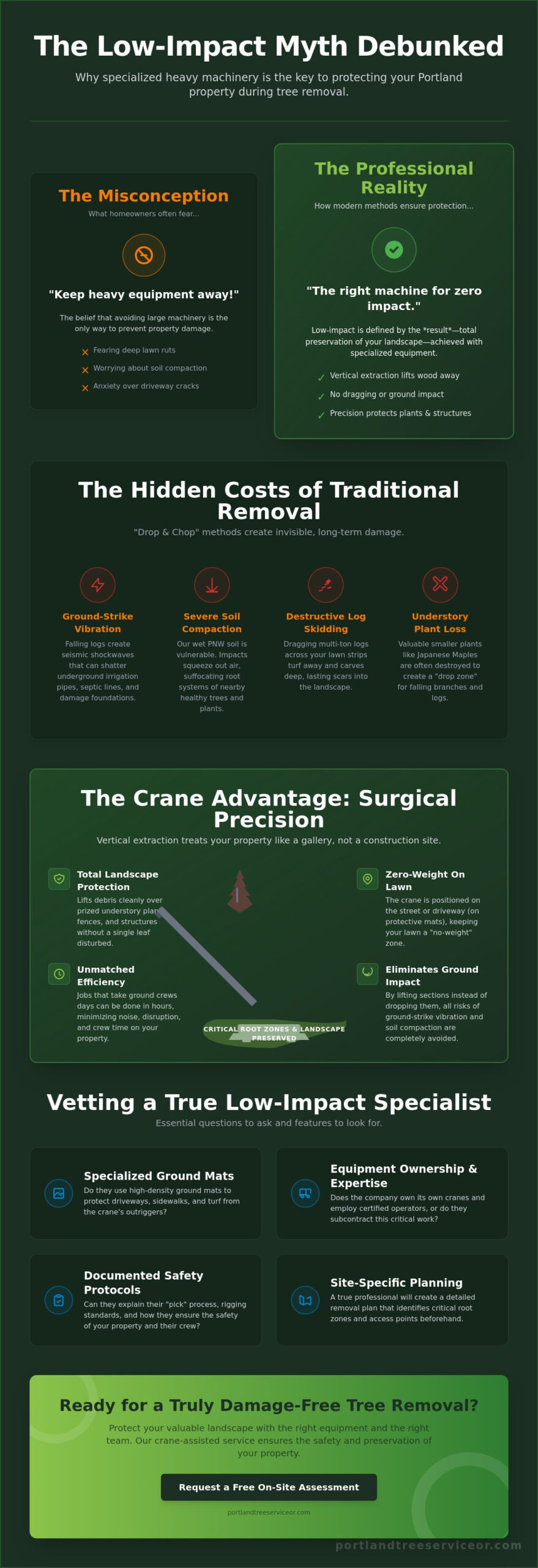
The traditional “drop and chop” method relies on gravity. When a massive trunk hits the ground, it creates a ground-strike vibration that can shatter underground septic lines or crush irrigation pipes. These impacts are often invisible until months later when a lawn begins to fail or a pipe bursts. In 2026, Portland standards have shifted to prioritize aerial extraction as the gold standard for low impact tree removal because it eliminates these seismic risks entirely.
The Hidden Danger of ‘Ground Strike’ in Portland Yards
Our wet Pacific Northwest soil is particularly vulnerable to heavy impacts. When a multi-ton log falls, it instantly compacts the earth, squeezing out the air pockets that roots need to breathe. This suffocates the root systems of nearby healthy trees and ruins the soil structure for future planting. By lifting sections away, we avoid the shockwaves that damage hardscaping and underground utilities. This methodical approach protects the long-term health of your entire landscape, not just the area immediately around the tree.
Manual Removal vs. Mechanical Precision
While manual climbing is a core part of professional arboricultural methods, relying on it for large removals in tight spaces increases the risk of human error and property damage. A crane provides a level of control that ropes simply cannot match. The repeated foot traffic of a large ground crew can actually cause more long-term soil compaction than a single, stationary crane setup positioned on protective mats.
The Crane Advantage: Why Lifting is Safer Than Dropping
Vertical extraction is the cornerstone of modern low impact tree removal. Instead of allowing gravity to dictate where a branch lands, a crane allows an operator to lift sections directly up and away from your property. This method completely eliminates “skidding,” which is the destructive practice of dragging heavy logs across a lawn. Skidding often strips away turf and destroys the delicate soil structure underneath, leaving behind deep scars that can take seasons to heal.
Many Portland properties feature a layered landscape with valuable “understory” plants like Japanese Maples or rhododendrons nestled beneath larger canopy trees. Traditional methods often sacrifice these smaller specimens to clear a path for falling limbs. A crane-assisted approach treats your garden like a gallery, lifting debris over your prized plants without disturbing a single leaf. This precision also leads to significant efficiency gains. A job that might take a ground crew two days to dismantle can often be completed in a few hours with a crane. To understand exactly how a tree is removed with a crane using this surgical pick-and-place technique, our step-by-step guide walks through every phase of the process. This reduces the total time heavy machinery and crews spend on your property, further minimizing the risk of accidental damage.
Protecting Your ‘Critical Root Zone’
The area directly beneath a tree’s canopy is known as the critical root zone. This space is vital for the health of neighboring trees and shouldn’t be used as a staging ground for heavy debris. Our crane tree removal service prioritizes keeping all major weight on the street or driveway. By positioning the crane on the hardscape, we ensure that your lawn remains a “no-weight” zone throughout the entire project. This prevents the long-term root damage that often follows less sophisticated removal methods.
Precision Rigging and Safety
Every removal involves a meticulous “pick” process. A climber secures each section with high-strength rigging before a single cut is made. Once the piece is severed, the crane takes the full weight immediately, preventing any uncontrolled movement. You can see this level of landscape protection in action by reviewing our large tree removal Portland case study. Understanding these technical details is an important part of learning how to hire a tree care professional who respects your property as much as you do. If you’re facing a complex situation, our team provides expert tree removal solutions tailored to your specific landscape needs.
Choosing a Low Impact Tree Service in Portland, Lake Oswego, and West Linn
Selecting the right specialist for a low impact tree removal involves more than just comparing quotes. You must verify that the team has the specialized equipment and local knowledge to handle our unique Pacific Northwest challenges. Start by asking if the company owns their cranes. Owning the fleet ensures the crew is intimately familiar with the machine’s limits and safety protocols. Sub-contracting often leads to communication gaps that put your property at risk during complex maneuvers.
A true professional uses heavy-duty ground protection mats to distribute weight across driveways and paths. In Lake Oswego and West Linn, where residential access is often tight and steep, these mats are essential for preventing the driveway cracks and soil ruts that common trucks leave behind. Before any equipment arrives, a comprehensive tree risk assessment is the first step. This evaluation determines the safest “pick” points and extraction path to avoid damaging your home or underground utilities. If you want a deeper understanding of the technical steps involved in this process, our guide on how a tree is removed with a crane step-by-step covers the NCCCO-certified operator protocols and rigging procedures your contractor should be following.
Questions to Ask Your Arborist
- What is your specific plan for protecting my septic or irrigation lines from heavy equipment?
- How will you ensure the weight of the crane is distributed to prevent cracking my driveway?
- Can you perform the extraction without any heavy debris hitting my lawn or garden beds?
The Portland Tree Service Difference
Our team brings over 30 years of local experience managing massive Douglas firs in our notoriously rainy conditions. We understand how saturated soil behaves and how to position equipment safely on various terrains. By utilizing high-level professional titles and specialized equipment for high-risk removals, we provide a level of security that general laborers cannot match. This seasoned expertise ensures that your low impact tree removal is executed with surgical precision, leaving your landscape pristine and your property protected.
Secure Your Property with Precision Tree Extraction
Protecting your landscape doesn’t mean compromising on the power of modern equipment. The most effective low impact tree removal strategies in 2026 rely on the surgical precision of cranes to eliminate ground-strike damage and soil compaction. By prioritizing vertical extraction over traditional felling, you ensure your driveways remain intact and your garden’s understory stays undisturbed. It’s about choosing the right tools for the job to maintain the health and beauty of your local environment.
Our team brings 30+ years of local Portland experience to every project. We utilize specialized crane equipment for zero-lawn-contact, ensuring your property is treated with the respect it deserves. We are fully licensed, bonded, and insured for high-risk work, providing the peace of mind you need for complex removals. When you are ready to move forward, Get a Low-Impact Tree Removal Estimate for Your Portland Property and secure the future of your landscape. You don’t have to choose between a safe removal and a beautiful lawn. With the right expertise, you can have both.
Frequently Asked Questions
Does low impact tree removal cost more than traditional removal?
Crane-assisted tree removal often requires a higher initial investment compared to traditional felling due to the specialized machinery and expert operators involved. However, this method frequently results in lower overall project expenses because it eliminates the need for expensive lawn repairs, driveway patching, or replanting damaged gardens. By avoiding ground strikes, you save on the hidden costs of property restoration that often follow standard removals.
Can a crane reach a tree in my backyard if there is no truck access?
Modern cranes feature telescopic booms that can safely reach over rooftops and structures to access backyard trees from a street or driveway. This capability allows for a low impact tree removal even in high-density neighborhoods where traditional truck access is physically impossible. We position the equipment on a stable hardscape and lift the tree sections vertically over any obstacles, ensuring nothing touches your home or delicate landscaping.
How do you protect my lawn from heavy crane stabilizers?
We protect your lawn and hardscaping by using oversized outrigger pads and specialized ground protection mats. These tools distribute the crane’s weight across a much larger surface area, which prevents the stabilizers from sinking into the turf or cracking your concrete. This methodical setup ensures that the heavy equipment remains stable and safe without leaving a lasting footprint on your property.
Is low impact removal possible during the rainy Portland winter?
Performing a low impact tree removal during the rainy Portland winter is actually highly effective because it prevents soil damage when the ground is most saturated. Traditional methods often cause severe ruts and deep compaction in wet mud; however, a crane allows us to extract the tree without any heavy logs or equipment ever touching the soft earth. This keeps your yard intact even during our most challenging weather months.