What if you could remove a massive, 80-foot oak from your backyard without a single heavy branch ever touching your lawn or driveway? Most homeowners feel a knot of anxiety when they think about traditional tree felling, especially when a hazardous trunk looms over their roof. You want the danger gone, but you’re just as worried about heavy equipment or falling debris causing permanent damage to your landscape. It’s a valid concern that our veteran teams have addressed with technical precision for decades.
This guide explains exactly how is a tree removed with a crane, providing a surgical “pick-and-place” alternative that eliminates the traditional felling zone entirely. You’ll discover the technical steps our experts use to secure and lift sections with steady control. We’ll also cover the safety protocols that professional operators follow, including the NCCCO certifications required by OSHA as of 2026. By the end of this article, you’ll understand why crane-assisted tree removal is the gold standard for property protection and how to prepare your landscape for a seamless, stress-free operation.
Key Takeaways
- Eliminate the risk of property damage by understanding how vertical extraction removes the dangerous drop zone common in standard felling.
- Master the technical details of how is a tree removed with a crane, from calculating ground pressure to setting stabilizing outriggers.
- Gain confidence in the rigging process where expert climbers secure each section with specialized slings for a controlled, steady lift.
- Prepare your landscape for the arrival of heavy machinery by identifying the ideal landing zone and clearing paths for log trucks.
- Ensure a safe operation by verifying the location of overhead wires and underground septic lines before the crane is deployed.
Why Crane-Assisted Tree Removal is the Gold Standard for Safety
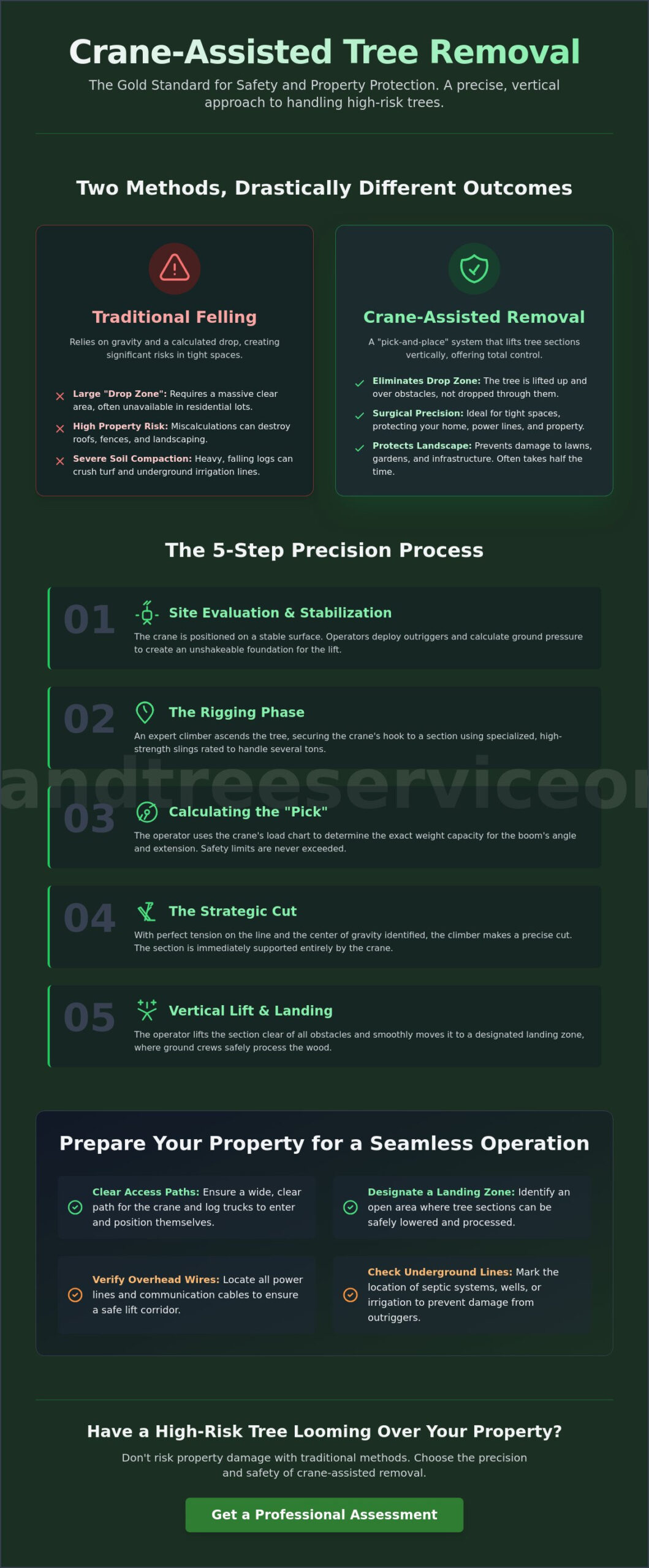
When property owners ask how is a tree removed with a crane, they’re often seeking a way to mitigate high-stakes risks. Crane-assisted removal represents the pinnacle of modern arboriculture. It utilizes a specialized “pick-and-place” system where our experts cut the tree into manageable sections and lift them vertically. This method is fundamentally different from traditional felling. Instead of dropping heavy logs onto your lawn, we secure each piece before the cut is even made. This allows us to maintain total control over every pound of wood from the canopy to the ground.
Traditional felling creates a large “drop zone” that can be incredibly risky for residential lots in Lake Oswego and Portland. In these tight quarters, there’s often no room for error. A single miscalculation can send a limb through a roof or a fence. By using a crane, we eliminate this zone entirely. We lift the tree over obstacles rather than through them. This approach also prevents severe soil compaction. Falling logs can crush irrigation lines and ruin expensive turf; a crane ensures your landscape remains undisturbed.
In 2026, efficiency is more important than ever for managing property maintenance. Crane operations often take half the time of manual rigging and climbing. This speed reduces the hours our crew spends on your property, which helps manage overall labor costs while providing a safer environment for everyone involved. Understanding the full benefits of crane tree removal can help Portland homeowners make a confident, informed decision before scheduling their extraction.
Surgical Precision in Tight Portland Spaces
Navigating the dense urban canopy in West Linn and older Portland neighborhoods requires a high level of discipline. Vertical extraction is the process of lifting tree sections directly upward to avoid nearby structures. This surgical approach is essential for protecting your home. Utilizing a professional crane tree removal service is the most reliable way to handle trees overhanging roofs or delicate power lines. When homeowners ask how is a tree removed with a crane, they’re often surprised by the grace of the operation. It’s a controlled, methodical process that prioritizes the integrity of your property above all else.
How is a Tree Removed with a Crane? The 5-Step Process
To fully understand how is a tree removed with a crane, you must look at the sequence of a technical lift. Our master craftsmen follow a disciplined five-step protocol to ensure every extraction is predictable and safe. This methodical approach transforms a high-risk task into a controlled mechanical operation.
- Step 1: Site Evaluation and Stabilization. We begin by positioning the crane on a stable surface. Our operators set outriggers and calculate ground pressure to prevent the machine from shifting during the lift.
- Step 2: The Rigging Phase. A skilled climber ascends the tree to secure the crane’s hook. We use specialized high-strength slings that are rated for several tons to ensure the connection is unbreakable.
- Step 3: Calculating the “Pick.” This is where physics meets expertise. The operator uses the crane’s load chart to determine the exact weight capacity for the current boom angle. We never exceed these limits.
- Step 4: The Strategic Cut. Once the operator maintains the perfect amount of tension on the line, the climber makes a precise cut. The section is then supported entirely by the crane.
- Step 5: The Vertical Lift and Landing. The operator lifts the section clear of all obstacles. It’s moved to a designated landing zone where ground crews safely process the wood into manageable logs or chips.
If you’re dealing with a hazardous tree near your home, exploring our professional crane services can provide the peace of mind you need.
The Critical Partnership: Climber and Operator
The success of the lift depends on the seamless communication between the climber and the operator. We use clear radio signals to maintain total control as the wood is separated from the trunk. A primary focus is identifying the center of gravity for each cut. Finding this balance point prevents the log from kicking or swinging unexpectedly when it’s released. When we perform large tree removal Portland residents often watch as we break 100-foot giants into manageable 2,000-pound sections. This level of precision ensures that even the largest trees are handled with the same care as a small ornamental. It’s a disciplined partnership that guarantees your property remains untouched throughout the process.
Preparing Your Property for a Crane Tree Removal in 2026
Preparation is the foundation of a successful extraction. Understanding how is a tree removed with a crane helps you visualize the space required for our team to work effectively. While our crews handle the technical rigging, homeowners play a vital role in ensuring the site is ready for heavy equipment. This coordination minimizes delays and maximizes the safety of your home and family.
We require a flat, open area designated as the landing zone. This space is essential for the wood chipper and log truck to process tree sections as they are lowered. Before our arrival, please identify any underground hazards like septic tanks or irrigation lines that might be sensitive to pressure. We also conduct a thorough utility check to ensure overhead wires are clear of the crane’s planned boom path. Safety is our primary anchor. We ask that all family members and pets remain inside during the high-risk “pick” phase to ensure the perimeter stays secure.
Notifying your Lake Oswego or West Linn neighbors is a courteous and necessary step for street access. Crane operations often require temporary lane closures or extra curb space for support vehicles. A quick conversation with those nearby prevents parking conflicts and keeps the project moving on schedule. Our goal is to complete the job with minimal disruption to the local community.
Protecting Your Landscape and Driveway
We take immense pride in leaving your property better than we found it. Our team uses specialized crane mats to distribute the machine’s weight, which prevents driveway cracking and soil ruts. These low impact tree removal techniques are designed to preserve your 2026 landscaping investments. Our cranes allow us to work from the street, often never touching your grass. By choosing a crane-assisted method, you ensure that your ornamental beds and healthy turf remain untouched by falling debris or heavy foot traffic. For a deeper look at why this approach outperforms traditional methods, reviewing the documented benefits of crane tree removal for Portland properties provides valuable context for your planning.
Secure Your Property with Precision Crane Extraction
Choosing a crane-assisted method transforms a hazardous removal into a surgical, low-impact operation. By eliminating the traditional felling zone and utilizing vertical extraction, you protect your home, roof, and landscape from the unpredictable nature of falling limbs. Professional rigging and precise weight calculations ensure that every section of the tree is controlled from the canopy to the landing zone. Now that you’ve seen the technical details of how is a tree removed with a crane, you can move forward with the confidence that your property is in expert hands.
Our team brings over 30 years of local Portland experience to every project. We maintain a specialized heavy-duty crane fleet designed specifically for tight residential spaces and high-risk removals. We are fully licensed, bonded, and insured, providing a layer of security that only seasoned veterans can offer. We take pride in our workmanship and our commitment to preserving the beauty of our local neighborhoods. You don’t have to settle for the risks of traditional felling when a safer, more efficient solution is available.
Ready to protect your landscape? Request a Professional Crane Removal Estimate in Portland today. We look forward to providing the reliable, expert service your home deserves.
Frequently Asked Questions
How much space does a crane need to remove a tree?
A crane typically requires a flat, stable area approximately 12 feet wide for the vehicle body and up to 24 feet of total width once the stabilizing outriggers are fully extended. We often utilize residential driveways or public street parking to set up the equipment. This footprint ensures the machine remains perfectly balanced during heavy lifts. It’s also necessary to have a clear vertical path for the boom to swing without hitting power lines or neighboring structures.
Can a crane remove a tree that is already dead or decaying?
Cranes are often the safest option for dead or decaying trees because they eliminate the need for a climber to put their weight on a compromised trunk. When considering how is a tree removed with a crane in these scenarios, our experts focus on securing the load to sound wood or using specialized rigging that doesn’t rely on the tree’s structural integrity. This “pick-and-place” method prevents the sudden, uncontrolled collapses that can happen during traditional felling of rotting timber.
Is crane tree removal more expensive than regular tree removal?
While the specialized equipment involves a higher initial setup cost, the efficiency of the process often reduces the total labor hours required on your property. Crane-assisted removals generally take significantly less time than manual climbing and rigging. This speed, combined with the near-elimination of potential property damage costs, makes it a high-value investment for homeowners with complex or hazardous trees. It’s a cost-effective way to ensure your landscape remains untouched.
What happens if a tree is too large for the crane’s reach?
If a tree is positioned beyond the reach of a standard boom, we utilize larger capacity cranes with extended reach or implement a hybrid removal strategy. Our team evaluates the distance and weight of the tree during the initial site visit to select the appropriate machine from our fleet. In some cases, we may combine traditional climbing techniques with crane assistance to safely bring sections within the lift radius. This ensures even the most remote trees on a large lot are handled with technical precision.