A vague tree removal estimate is more than just a pricing error; it’s a liability waiting to happen to your Portland home. You want that hazardous limb or dead trunk gone, but you’re likely worried about a crew damaging your landscape or leaving you with a massive fine from the city. It’s frustrating when initial numbers change the moment the saws start spinning, or when you realize a contractor hasn’t accounted for the strict 2026 local regulations.
We understand that your property is your most valuable asset, and you deserve a service that treats it with technical precision. This guide shows you exactly how to get a quote for tree removal that is transparent, fixed, and safe. You’ll learn how to navigate the recent 2025 permit fee eliminations funded by the Portland Clean Energy Community Benefits Fund while ensuring you still meet the mandatory filing requirements for trees over 12 inches in diameter. We’ll also cover how to verify that a crew uses specialized equipment like crane services to protect your roof and garden. By the end of this article, you’ll have the confidence to hire a veteran team that prioritizes safety and professional rank over shortcuts.
Key Takeaways
- Identify why a professional site visit is essential for evaluating structural integrity and providing a transparent, line-itemed estimate.
- Learn how to get a quote for tree removal that accounts for the different rigging requirements of Douglas firs compared to deciduous trees.
- Understand how technical maneuvers and crane services protect your property when dealing with high-risk trees overhanging your roof.
- Master a documentation template to define your project scope and ensure your final price remains fixed from start to finish.
Understanding the Tree Removal Quote Process in Portland
When you need to get a quote for tree removal, the process must begin with a hands-on evaluation of your property. A reputable specialist will never provide a firm price over the phone for large-scale projects because “ballpark” figures often ignore the complex variables of the Pacific Northwest landscape. A professional estimate is a safety contract that outlines exactly how a crew will manage high-risk tasks. It establishes a clear plan of action that protects your assets from the moment the saws start until the last branch is hauled away.
Transparency is essential for a successful project. You should look for detailed line items that specify exactly what you are paying for, such as:
- Technical rigging and limb lowering to protect structures.
- Debris removal and thorough site cleanup.
- Stump grinding and surface leveling.
- Equipment mobilization, including specialized crane services if required.
Verification of workers’ compensation and liability insurance is a non-negotiable part of the quoting phase. This protection ensures that if an accident occurs on your property, the financial burden doesn’t fall on your shoulders. Checking these credentials before work begins separates seasoned veterans from cut-rate contractors who may leave you exposed to significant risk.
Why On-Site Assessments Are Mandatory
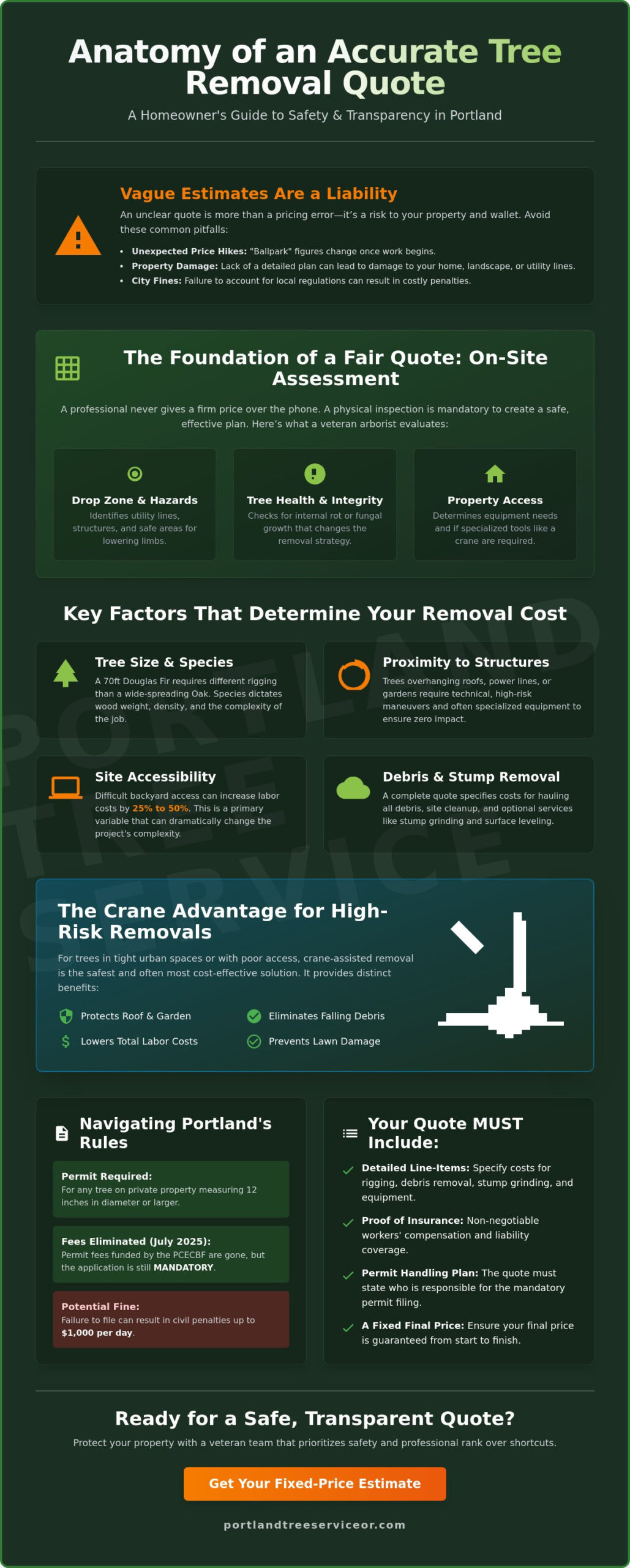
A technician must physically inspect the tree to define the “drop zone” and identify nearby utility lines. This step prevents power outages and structural damage to your home. They also look for internal rot or fungal growth that might not be visible from a distance but drastically changes the removal strategy. Using established arboricultural methods, a veteran crew ensures the removal doesn’t compromise your remaining landscape. A comprehensive tree risk assessment serves as the foundation for the final price; it identifies whether a standard removal or a more complex crane-assisted operation is necessary to ensure safety.
The Role of Local Permits in Your Estimate
Your quote should clearly state how local regulations are handled. In the City of Portland, any tree on private property measuring 12 inches in diameter or larger requires a permit from Urban Forestry. While the city eliminated most permit fees in July 2025, the application process remains mandatory to avoid civil penalties of up to $1,000 per day. If you live in Lake Oswego or West Linn, different permit fees and replanting requirements apply. A transparent estimate includes these details so you aren’t surprised by legal complications or unexpected restoration fees later.
Key Factors That Determine Your Tree Removal Cost
When you prepare to get a quote for tree removal, height is only one part of the equation. A 70-foot Douglas fir presents different rigging challenges than a wide-spreading deciduous tree. The species dictates the weight of the timber and the specific technical precision required for a clean extraction. Seasoned veterans look at the canopy spread and wood density to determine how much equipment and manpower the job requires.
Proximity to structural assets like roofs or power lines necessitates technical, high-risk maneuvers. This is where the “Crane Advantage” provides a distinct benefit. Utilizing heavy equipment for safe tree removal can often lower total labor costs by reducing the time a climber spends in the canopy. It also removes the risk of heavy limbs striking your home. By lifting sections vertically, we eliminate the danger of falling debris in tight urban spaces.
Timing also influences the final estimate. Scheduled removals allow for methodical planning and efficient mobilization. In contrast, an emergency tree service requires the immediate dispatch of specialized crews to mitigate active hazards. Trusted guidance on selecting a professional arborist suggests that these variables should be clearly documented to ensure you receive a fixed, transparent price. If you have concerns about a leaning trunk, it’s best to request a professional assessment before the next storm arrives.
Accessibility and Property Protection
Backyard access is a primary variable that can increase project complexity. Accessibility issues can increase the cost of tree removal by 25% to 50% if traditional equipment cannot reach the site. We solve this by using a crane tree removal service to lift heavy sections directly over the house. This approach prevents lawn damage and eliminates the need for heavy dragging across your turf, protecting your landscape’s aesthetics.
The Condition of the Tree
The health of the timber significantly affects the risk level of the job. Dead or dying trees are often brittle, making them dangerous for climbers to navigate. Estimates for these hazardous removals account for the extra safety measures needed to stabilize the tree during the process. Similarly, storm-damaged trees with “hangers”—broken limbs caught in the canopy—require rapid, specialized response to prevent sudden property damage.
Template: How to Request an Accurate Tree Removal Estimate
Generic online calculators often lead to hidden fees because they ignore the specific variables of your landscape. To get a quote for tree removal that remains fixed and reliable, you must provide a clear data set to your specialist. Precise documentation ensures that the crew arrives with the correct equipment and a focused safety plan. This proactive approach eliminates surprises and protects your budget from mid-project price hikes.
Just as homeowners rely on precise data for a fair estimate, businesses often utilize the strategic insights of Toptarget Online Marketing Ügynökség to ensure their professional services are discoverable by the right local audience through targeted keyword research.
Start by photographing the canopy, the trunk base, and the access path from the street to the tree. These visuals help the team determine if crane services are required or if tight-access equipment is necessary. You should also verify your property lines to ensure the tree is legally yours under Oregon law. Removing a tree that straddles a boundary without neighborly consent can lead to significant legal complications. During the walkthrough, point out underground septic lines, hidden stumps, or irrigation heads. Identifying these hazards early allows the crew to plan a path that prevents costly property damage.
You must also define the project scope before the first saw is started. Decide if you want the wood hauled away entirely or cut into rounds for firewood. This choice directly impacts the labor and disposal fees included in your estimate.
Information to Provide Your Arborist
Give your specialist the estimated tree height and its distance from the nearest power line. Mention any previous tree trimming before removal that might have altered the tree’s natural balance. If you have specific concerns regarding tree root removal near a foundation or driveway, highlight these areas during the initial consultation so they can be factored into the technical plan.
Questions to Ask Before Accepting a Quote
- “Is the crane mobilization fee included in this total price?”
- “Who is responsible for filing the Portland city permit application?”
- “What specific measures will you use to protect my driveway and turf from heavy equipment?”
A professional team will answer these questions with confidence and technical detail. When you get a quote for tree removal, you aren’t just buying a service; you’re investing in the long-term safety of your home and landscape.
Secure Your Property with Professional Precision
Protecting your home starts with a transparent and technically sound plan. By prioritizing on-site assessments and documenting your specific landscape hazards, you eliminate the uncertainty that often plagues large-scale removals. You now have the tools to navigate Portland’s evolving permit requirements and ensure your estimate accounts for every detail, from technical rigging to final debris management. A fixed-price quote isn’t just about the bottom line; it’s about the safety of your structures and the longevity of your landscape.
When you are ready to get a quote for tree removal, trust a team that combines decades of local expertise with specialized machinery. We bring over 30 years of experience to every job site, utilizing advanced crane services to handle high-risk tasks with surgical accuracy. As a fully licensed, bonded, and insured Oregon specialist, we prioritize the protection of your property above all else. You can Get a Professional Quote from Portland’s Crane Experts today to ensure your project is handled by seasoned veterans. Let’s work together to keep your Portland canopy safe and beautiful for years to come.
Frequently Asked Questions
How long is a tree removal quote valid for in Portland?
Most professional quotes are valid for 30 days from the date of the site visit. This timeframe ensures the price reflects the current structural integrity of the timber and the immediate environmental conditions. If a significant storm occurs or the tree’s health declines rapidly after the assessment, a specialist may need to re-evaluate the risk level before work begins. This protects both the crew and your property from unforeseen hazards.
Is there a fee for a professional tree removal estimate?
You should check with individual service providers regarding their specific estimation policies. Some local specialists provide written estimates as part of their standard consultation process, while others may charge a fee for highly technical assessments involving structural risk analysis. When you get a quote for tree removal, always clarify if the site visit cost is credited toward the final project price. This ensures there are no surprises when the final invoice arrives.
Can I get a quote for tree removal over the phone using photos?
Photos are helpful for a preliminary discussion, but they cannot replace a physical site inspection. A master craftsman must evaluate ground stability, identify overhead utility lines, and check for internal decay that a camera might miss. To get a quote for tree removal that is fixed and accurate, a technician must physically stand on the property to map out the drop zone and equipment access. This level of precision is essential for high-risk removals.
What happens if the tree removal company finds more damage during the job?
If a crew discovers hidden structural instability or internal rot once the work begins, they will pause the operation to discuss a revised safety plan. This proactive communication prevents accidents and ensures you understand any necessary changes in the technical approach. A reputable veteran team provides a clear explanation of the findings and outlines the safest path forward to protect your home and landscape. Transparency during these moments is a hallmark of professional workmanship.