A leaning tree is a structural equation where root stability and lean speed matter more than the angle itself. When you see a tree leaning towards house structures on your property, the immediate fear of catastrophic damage is a heavy burden to carry. You’re right to be concerned. A tilt that seems minor during a calm afternoon can become a major liability when the next windstorm hits. It’s often difficult to distinguish between a tree that has safely corrected its growth and one that’s actively failing at the root level.
We understand the stress of protecting your home while managing the potential costs of high-risk removal. This article will help you identify dangerous tree leans, perform an initial safety assessment, and choose the right professional solution to protect your property. You’ll gain a clear understanding of tree failure signs and a step-by-step plan to mitigate risk. We’ll also explain how specialized crane services allow experts to safely remove hazardous trees from tight spaces without impacting your landscaping or home.
Key Takeaways
- Learn to distinguish between natural growth patterns and sudden structural shifts that indicate a high risk of root failure.
- Establish an immediate safety perimeter and document a tree leaning towards house structures to streamline insurance claims and professional assessments.
- Understand the limitations of cabling and bracing for trees experiencing root-plate instability or severe soil displacement.
- Discover how specialized crane services provide a safe, precision solution for removing hazardous trees in confined spaces near your home.
Evaluating the Risk: Is Your Leaning Tree a Danger to Your Home?
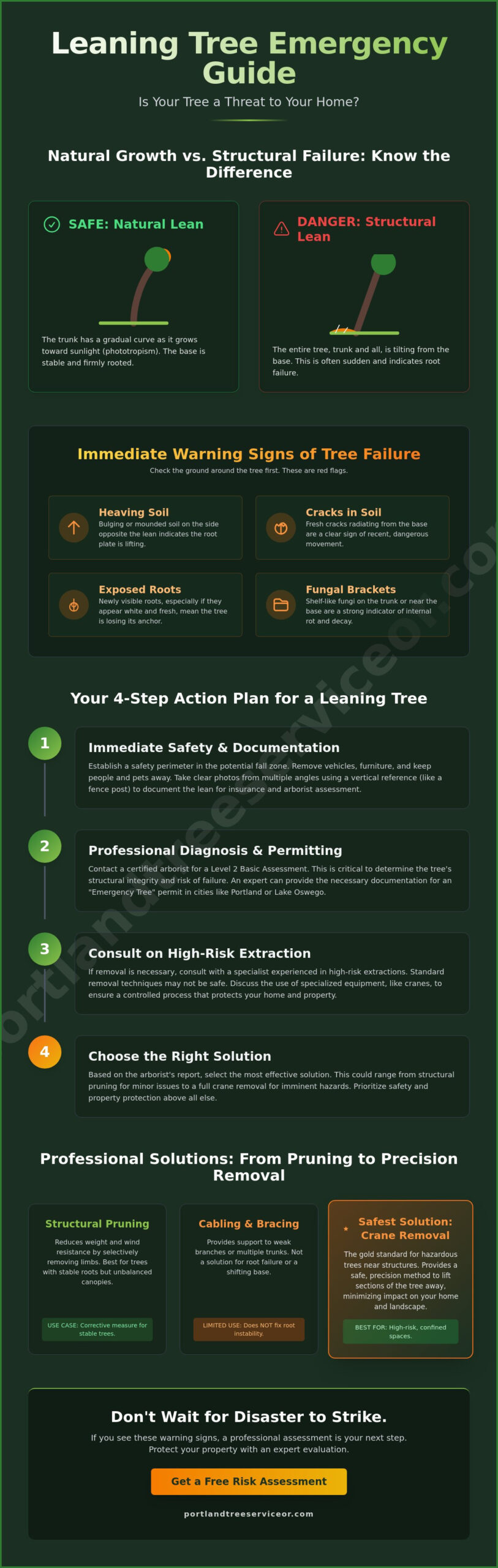
A tree leaning towards house structures isn’t always a sign of impending disaster, but in the Pacific Northwest, the context changes quickly. Most trees exhibit some degree of phototropism, where they naturally grow toward sunlight. This results in a curved trunk that remains structurally stable over decades. A structural lean is different; it involves the entire trunk tilting from the base, often leaving the tree straight but off-center. In Portland, our saturated winter soils play a critical role in destabilizing root plates. When the ground becomes waterlogged, the soil loses its grip on the roots of heavy species like Douglas firs and Western Red Cedars. This makes even a slight increase in lean angle a serious concern during high-wind events.
Immediate Warning Signs of Tree Failure
You can often spot a failing tree by looking at the ground before you look at the canopy. Check the side opposite the lean for heaving or bulging soil, which indicates the root plate is physically lifting out of the earth. Fresh cracks in the soil or newly exposed white roots are clear indicators of recent, dangerous movement. You should also inspect the base of the trunk for hazard brackets. These shelf-like fungal growths signal internal rot and advanced decay. These signs suggest the tree’s internal structure is compromised and requires a professional tree risk assessment to determine if the tree leaning towards house areas can be stabilized or if it must be removed. Knowing how to recognize the signs of a dying tree can help you catch these structural problems before they escalate into a full emergency. After any major Oregon storm, conducting a thorough post storm tree inspection is essential to catch these hidden hazards before they escalate into emergencies.
The “Target” Factor in Risk Assessment
A leaning tree is only as dangerous as the objects in its path. Professionals evaluate the target, which is anything of value the tree would hit if it fell. If your tree leans toward a bedroom, power lines, or a main structural wall, the risk level escalates from a maintenance issue to a potential emergency. Because a falling Douglas fir can weigh several tons, identifying these high-value targets is the first step in property protection. For a definitive safety plan, a comprehensive tree risk assessment is necessary to weigh the likelihood of failure against the potential impact on your home.
How to Manage a Leaning Tree: A 4-Step Action Plan
Managing a leaning tree requires a disciplined approach to prevent property damage. You need a clear sequence of actions to move from uncertainty to a controlled resolution. This starts with securing the site and ends with an expert extraction that protects your home and landscape.
Step 1: Immediate Safety and Documentation
Your first priority is to establish a safety perimeter. Clear the potential fall zone of vehicles, outdoor furniture, and pets. A tree leaning towards house structures represents a massive weight load that could shift without warning. Once the area is clear, document the lean with high-quality photos from multiple angles. Take at least one “straight-on” photo using a nearby vertical structure, such as a fence post or the corner of your home, as a reference point. This visual evidence is crucial for Evaluating the Risk when you present your case to an insurance adjuster or a professional arborist.
Step 2: Professional Diagnostic and Permitting
A simple visual check isn’t enough for high-risk scenarios. You need a Level 2 Basic Assessment to determine the tree’s structural integrity. This professional review examines the trunk, root flare, and site conditions to calculate the likelihood of failure. In 2026, navigating the “Emergency Tree” permit process in the City of Portland or Lake Oswego is essential before starting work. Local regulations often require documented proof that a tree is an immediate hazard to bypass standard waiting periods. If the assessment confirms the danger, you should contact a specialist for tree removal to ensure the job is handled safely and legally.
Step 3: Consultation for High-Risk Extraction
Consult with a specialist who understands the physics of heavy-duty extractions. High-risk removals near residential structures require more than just a chainsaw. You need a team experienced in using specialized machinery to control the descent of every limb. Veterans in the industry prioritize property protection by using equipment designed to minimize impact on your yard. This methodical planning ensures that even a tree in a tight space is removed without compromising the safety of your home or the surrounding landscape.
Professional Solutions: From Structural Pruning to Crane Removal
Once you’ve assessed the risk, you must decide on the most effective path to protect your property. In some cases, structural pruning can save a tree by rebalancing the weight of the canopy. This process involves removing specific limbs to reduce the “sail area,” which lowers the wind load on the trunk during Portland’s heavy winter storms. However, if your assessment revealed root-plate failure or significant soil heaving, cabling and bracing have major limitations. These systems are designed to support weak branch unions; they cannot safely anchor a tree that’s physically detaching from the ground. Before committing to any solution, reviewing a comprehensive checklist of signs of a dying tree can help you and your arborist make a more informed decision about whether preservation or removal is the right course of action.
When a tree leaning towards house structures is deemed too hazardous to remain, traditional felling is rarely an option. Dropping a multi-ton Douglas fir in one piece requires a vast amount of clear space that most Portland or Lake Oswego residential lots simply don’t have. Attempting a standard felling in a tight space risks catastrophic damage to your roof, power lines, or neighboring property. For these high-risk scenarios, a professional crane tree removal service is the safest and most efficient solution available.
The Precision of Crane-Assisted Removal
Cranes provide a level of control that manual climbing cannot match. By securing the tree to a crane before any cuts are made, crews can lift sections vertically. This prevents heavy limbs from swinging toward your home or impacting your landscaping. Using heavy equipment is the gold standard for high-risk removals because it removes the unpredictability of gravity. It allows for a surgical extraction where every piece of the tree is moved away from the structure in a controlled, steady motion.
Choosing the Right Specialist for the Job
Not every tree company is equipped for high-risk extractions over residential structures. You should verify that your contractor carries specific insurance coverage for work performed directly over homes and buildings. When discussing the project, ask about the specific machinery they’ll use to navigate tight backyard access in neighborhoods like West Linn or Lake Oswego. Specialized equipment, such as compact lifts or long-reach cranes, is often necessary to minimize the impact on your yard. Our 30+ years of local experience ensures a safe, no-impact removal that prioritizes the long-term integrity of your property.
Secure Your Property with Professional Tree Care
Identifying a tree leaning towards house structures is the first step in a vital safety process. You now understand how to distinguish natural growth patterns from structural root failure and the critical role of saturated Pacific Northwest soils. By following a structured action plan, you can manage the risks of heavy Douglas firs or Western Red Cedars before they impact your home’s integrity.
When a hazard is confirmed, specialized crane equipment provides the only zero-impact solution for tight residential lots. Our team brings 30+ years of Portland tree care experience to every high-risk extraction. We prioritize the safety of your structures and the health of your landscape through methodical, precision work. If you’re concerned about a potential failure during the next storm, we offer an emergency 24/7 response for hazardous trees to provide immediate peace of mind. Request an Emergency Risk Assessment for Your Leaning Tree to protect your home today. You don’t have to face the next windstorm with uncertainty.
Frequently Asked Questions
Can a leaning tree be straightened without removing it?
Mature trees generally cannot be straightened once they’ve developed a structural tilt. While young saplings can sometimes be corrected with staking, a large tree has a massive root system and weight load that makes mechanical straightening impossible. Attempting to force a mature tree back to a vertical position usually causes severe root trauma and weakens the tree’s structural integrity even further. If the lean is caused by root-plate failure, removal is typically the only safe solution to protect your property.
How do I know if a leaning tree is an emergency?
A leaning tree is an emergency if you observe active movement or ground displacement. Signs of an immediate hazard include fresh cracks in the soil, exposed white roots, or a noticeable change in the lean angle after a storm. If a tree leaning towards house structures shows heaving soil at its base, the root system is no longer anchoring it securely. In these cases, the risk of a fall is extremely high and requires professional intervention before the next weather event occurs.
Does insurance cover the removal of a leaning tree before it falls?
Standard homeowner’s insurance policies don’t cover the cost of preventative tree removal. Carriers view the management of a leaning tree as a routine maintenance task for the property owner. You’ll likely be responsible for the full cost of the removal out of pocket. However, if the tree actually falls on a covered structure like your roof or garage during a windstorm, your policy will usually cover the damage to the structure and the subsequent debris removal costs.
What happens if my neighbor’s tree is leaning toward my house in Oregon?
Oregon law generally treats a tree falling during a storm as an act of nature, meaning you’d typically file a claim with your own insurance company. You can only hold a neighbor liable if you can prove they were negligent in maintaining a known hazard. To protect yourself, it’s a good idea to send a certified letter to your neighbor documenting the hazardous condition. This creates a formal record that may help establish liability if the tree eventually causes damage to your home.