A diseased Douglas fir on your Portland property is more than just an eyesore; it’s a structural ticking clock that doesn’t wait for a convenient time to fail. You likely feel a surge of anxiety every time an Oregon storm brings heavy winds through your neighborhood, wondering if those brittle branches will hold. It’s stressful to balance the fear of property damage against the confusion of local regulations and potential costs. This guide will show you exactly how to identify critical Pacific Northwest diseases and determine when to remove a diseased tree Portland to protect your home and family.
We understand that your property’s safety is your top priority, and we provide the technical expertise needed to manage these high-risk situations. You’ll learn to recognize when a tree becomes a “Dangerous” liability under Portland City Code Title 11. We also clarify the latest 2025 permit updates, such as the $0 fee for removal and replanting permits, while outlining the risks of the $1,000 daily penalty for unpermitted work. This article previews how professional crane services and emergency tree service provide a safe, low-impact solution for even the largest, most hazardous trees on your lot.
Key Takeaways
- Identify the early symptoms of regional diseases like Anthracnose to stop infections before they create permanent structural damage.
- Apply the “50% Rule” to determine exactly when to remove a diseased tree Portland according to City Code Title 11 standards.
- Distinguish between aesthetic leaf issues and “Dangerous” tree classifications to prioritize removals that protect your home’s foundation and roof.
- Learn why diseased wood requires specialized crane-assisted removal techniques to prevent unpredictable limb failure in confined urban yards.
- Evaluate your tree’s stability before storm season to decide if emergency tree service is necessary to mitigate property risk.
Common Tree Diseases in PNW: Identification and Impact
Pacific Northwest tree diseases are typically fungal or bacterial infections fueled by our region’s high moisture levels. These pathogens thrive in the damp, cool environment of the Willamette Valley, where they slowly compromise the biological health of your canopy. Understanding the basics of forest pathology helps you spot trouble before it leads to a total structural failure. Identifying these signs early prevents catastrophic property damage during the next windstorm. Knowing when to remove a diseased tree Portland homeowners often struggle with depends on whether the infection has reached the heartwood or structural roots.
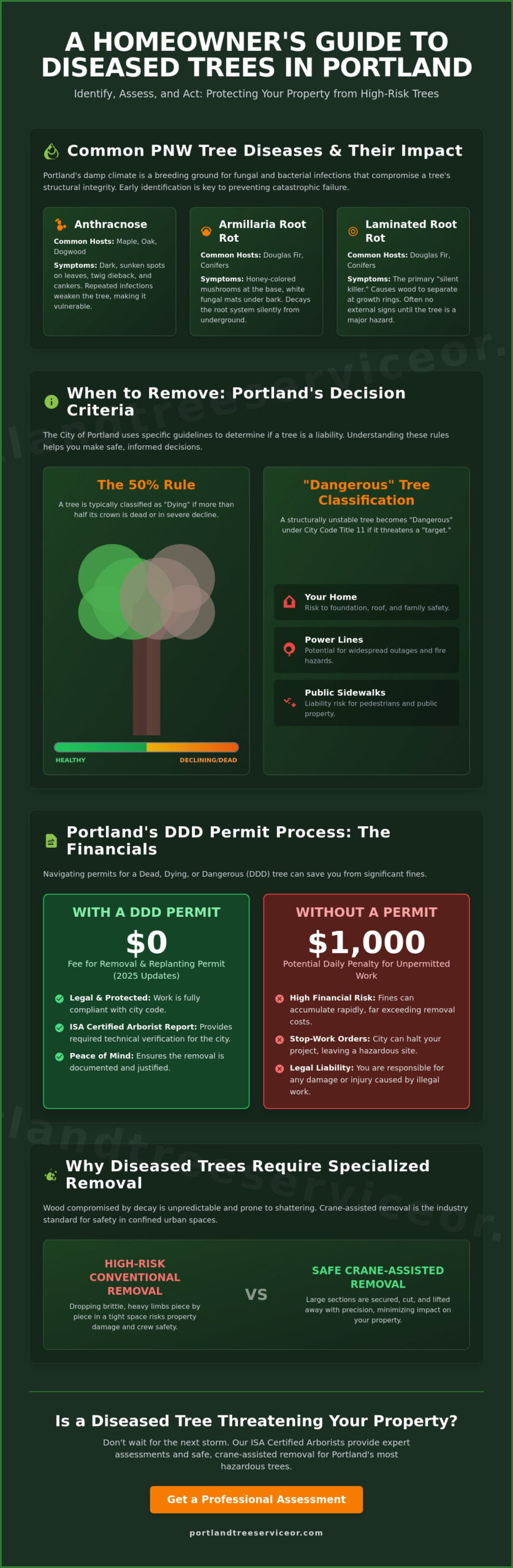
Anthracnose is a frequent culprit in Portland maples and oaks, manifesting as distinct leaf spotting and twig dieback. While it often appears cosmetic, repeated infections weaken the tree’s immune system. More sinister is Armillaria root rot, known as “shoestring fungus,” which silently decays the root system of Douglas firs. You might see mushrooms at the base, but the real damage is underground. Similarly, Laminated root rot stands as the primary silent killer of conifers in the region. It causes the wood to separate at the growth rings, turning a massive tree into a standing hazard with no visible external decay.
Why Portland’s Climate Accelerates Tree Decay
Consistent winter rainfall allows fungal spores to penetrate deep into bark fissures where they remain protected. As spring brings mild temperatures, these pathogens reproduce rapidly across urban canopies. In Portland’s high-density neighborhood plantings, we often see a high pathogen load. This term refers to the total volume of infectious biological agents present within a specific area’s tree population, which increases the risk of cross-contamination between your yard and your neighbor’s property.
Identifying Host-Specific Threats
Certain species face unique risks that require specialized attention. Black Walnut trees are susceptible to Thousand Cankers Disease, while Portland’s ornamental landscapes often battle Bronze Birch Borer infestations. These pests and fungi target specific vascular tissues, cutting off the tree’s ability to transport nutrients. You can find detailed species mapping and symptom checklists in our guide on common tree diseases in PNW. Recognizing these host-specific threats is a critical step in determining when to remove a diseased tree Portland property owners should not ignore.
When to Remove a Diseased Tree: Portland Decision Criteria
Deciding when to remove a diseased tree Portland homeowners often find difficult, especially when balancing emotional attachment with property safety. The City of Portland provides a clear framework through the “50% Rule.” Under this guideline, a tree is typically classified as “Dying” if more than half of its crown is dead or significantly declining. While aesthetic issues like minor leaf spot might be treatable, structural instability turns a sick tree into a “Dangerous” tree under Title 11 regulations. We prioritize your property’s safety by evaluating the “target,” which is the likelihood of a tree hitting your house, power lines, or the public sidewalk if it fails.
There is a definite “Point of No Return” where the cost of ongoing treatments and cabling outweighs the safety benefits of removal. If the tree’s internal transport system is too compromised, even the best care won’t restore its structural integrity. If you’re concerned about a specific specimen, our team can provide a professional assessment to determine if tree removal is the most responsible path forward.
The Dead, Dying, or Dangerous (DDD) Permit Process
Portland allows for a streamlined permit process when a tree meets DDD criteria. You must document the disease progression carefully; photos of the canopy and trunk are essential for city officials. An ISA Certified Arborist plays a critical role here by verifying the tree’s health and providing the technical reports required for city approval. Review our signs of a dying tree checklist to see if your tree currently qualifies for this expedited path.
Biological Red Flags That Require Immediate Removal
Certain indicators suggest internal heart rot that isn’t visible to the untrained eye. Conks and mushrooms growing at the base are fruiting bodies of fungi already consuming the tree’s core. Vertical cracks and seeping bark are equally alarming, as they signal that the internal transport system has failed. A tree leaning towards house combined with active root rot is a high-priority emergency that requires immediate intervention. Consult the city’s list of common tree pests and diseases in Portland to cross-reference your findings before scheduling an emergency tree service.
Safe Removal of Diseased Trees in Urban Portland
Diseased trees present a unique set of challenges compared to healthy specimens. While a healthy Douglas fir has a degree of elasticity, diseased wood becomes incredibly brittle and unpredictable during the felling process. This lack of structural integrity makes traditional climbing and rigging methods hazardous for both the crew and your property. Determining when to remove a diseased tree Portland residents should consider the high risk of sudden limb failure during the removal itself. We utilize specialized heavy-duty machinery to mitigate these risks and ensure a controlled, safe extraction.
Impact mitigation is a primary concern in our densely packed neighborhoods. When wood is compromised by heart rot or fungal infections, it can shatter upon impact with the ground. We use crane-assisted techniques to lift sections up and away from your home rather than dropping them. This prevents brittle debris from damaging your roof or landscape. After the tree is removed, stump grinding is essential. This process removes the primary host for soil-borne diseases, ensuring that pathogens don’t spread to your new plantings or your neighbor’s canopy.
Why We Use Cranes for Diseased Extractions
Using a crane is the most responsible way to handle a tree with advanced decay. It eliminates the need for our arborists to climb potentially hollow or unstable trunks that could collapse under a climber’s weight. Through precision lifting, we can clear 100-foot firs over Lake Oswego and West Linn homes with zero lawn impact. This method provides the highest level of safety for your property. You can see a full breakdown of our specialized equipment on our crane tree removal service page.
Emergency Response for Storm-Damaged Diseased Trees
Diseased trees are almost always the first to fail during Pacific Northwest wind events. Because their internal structure is already compromised, they lack the strength to withstand high-velocity gusts. It’s vital to schedule a post storm tree inspection to find hidden decay that may have been exacerbated by recent weather. Our team brings over 30 years of local experience to every job site. We understand the specific physics of compromised wood and provide a definitive solution for when to remove a diseased tree Portland homeowners find themselves worrying about after a storm.
Protecting Your Portland Property from Hazardous Decay
Identifying the biological signs of decay is the first step in maintaining a safe urban landscape. Once a tree meets the City of Portland’s “Dead, Dying, or Dangerous” criteria, prompt action is necessary to avoid the high costs of property damage or city penalties. Understanding when to remove a diseased tree Portland property owners face helps prevent the sudden failure of massive conifers during our intense seasonal storms. Leaving a brittle, sick tree standing near your home is a gamble that often ends in a high-stakes emergency tree service call.
Our team brings 30+ years of Portland tree care experience to every job site. We employ ISA Certified Arborists who understand the nuances of local city codes and utilize specialized crane equipment for high-risk removals. This technical precision ensures your home remains protected even during the most complex extractions in tight neighborhood lots. You can trust our seasoned veterans to handle the most hazardous conditions with care and efficiency. Get a Professional Tree Risk Assessment from Portland’s Crane Experts today. Taking these proactive steps now secures the longevity and safety of your property for years to come.
Frequently Asked Questions
Can I remove a diseased tree on my Portland property without a permit?
You generally cannot remove any tree 12 inches or more in diameter at breast height (DBH) without an approved permit. As of July 1, 2025, the City of Portland has eliminated the fee for “Tree Removal and Replanting” permits to help homeowners manage hazardous vegetation. However, the permit itself is still a legal requirement. Removing a tree without this authorization can lead to civil penalties of up to $1,000 per tree, per day.
How much of a tree must be dead before Portland allows removal?
The City of Portland typically requires a tree to be at least 50% dead or in a state of significant decline to qualify as “Dying” under the permit criteria. This specific threshold is a primary factor in determining when to remove a diseased tree Portland urban forestry inspectors will authorize. If a tree hasn’t reached the 50% mark but shows signs of structural instability, it may instead be evaluated under “Dangerous” tree standards to ensure neighborhood safety.
Will a diseased tree always fall, or can it be saved with pruning?
Some trees can be saved through targeted structural pruning if the disease is limited to external branches or minor infections. However, pathogens that reach the heartwood or root system often cause irreversible damage. Once the internal support structure is compromised, the tree becomes a liability that pruning cannot fix. In these high-risk scenarios, professional tree removal is the most responsible way to protect your home and family from unpredictable failure.
What are the most common signs of root rot in Portland Douglas firs?
Douglas firs often signal root rot through a thinning canopy, yellowing needles, or a noticeable “distress crop” of small cones. You should inspect the base of the trunk for mushrooms or white fungal growth under the bark flares. These symptoms suggest the root system is decaying and can no longer anchor the tree against heavy PNW winds. Identifying these signs early allows you to schedule a controlled removal before the next major storm event.
How do I know if the fungus on my tree bark is dangerous?
Dangerous fungi typically manifest as woody, shelf-like brackets known as “conks” growing directly from the trunk or the root flare. These growths are the fruiting bodies of internal decay that has already reached the tree’s structural core. While some leaf-based fungi are merely cosmetic, these trunk-based structures are critical indicators of heart rot. If you see these brackets, it’s time to assess when to remove a diseased tree Portland safety codes classify as a “Dangerous” hazard.
Does homeowners insurance cover the removal of a diseased tree before it falls?
Most homeowners insurance policies do not pay for the removal of a standing diseased tree. Carriers generally classify tree health as a routine maintenance task that falls under the property owner’s responsibility. Coverage typically only applies after a tree has already fallen and caused documented damage to a covered structure like your house or garage. Investing in an assessment now prevents the stress and high costs associated with emergency tree service after a collapse.