Did you know that during the January 2024 ice storm, Portland’s Urban Forestry department received 770 calls from residents about downed trees in just a matter of days? When the winds die down and the ice melts, the immediate relief often gives way to a lingering anxiety about the giants standing over your home. Performing a thorough post storm tree inspection is the only way to ensure that “widowmakers” or saturated soil haven’t turned your backyard into a hazard zone. Many structural failures aren’t obvious at first glance, and waiting for the next gust to reveal a weakness can lead to devastating property damage.
In addition to structural damage to buildings, storms often result in fallen limbs trapping or damaging vehicles. In these situations, professional Emergency Towing is often necessary to safely remove the car from the hazard zone before tree removal crews can begin their work.
We understand the stress of wondering if a leaning tree is a ticking time bomb or if a DIY fix is even possible. This article provides a clear checklist to help you spot hidden hazards like root plate lifting and internal trunk decay. You’ll learn to identify exactly when a situation requires professional tree removal or specialized crane services. By the end of this guide, you’ll have the expert knowledge needed to make informed decisions and regain peace of mind regarding your property’s safety.
Key Takeaways
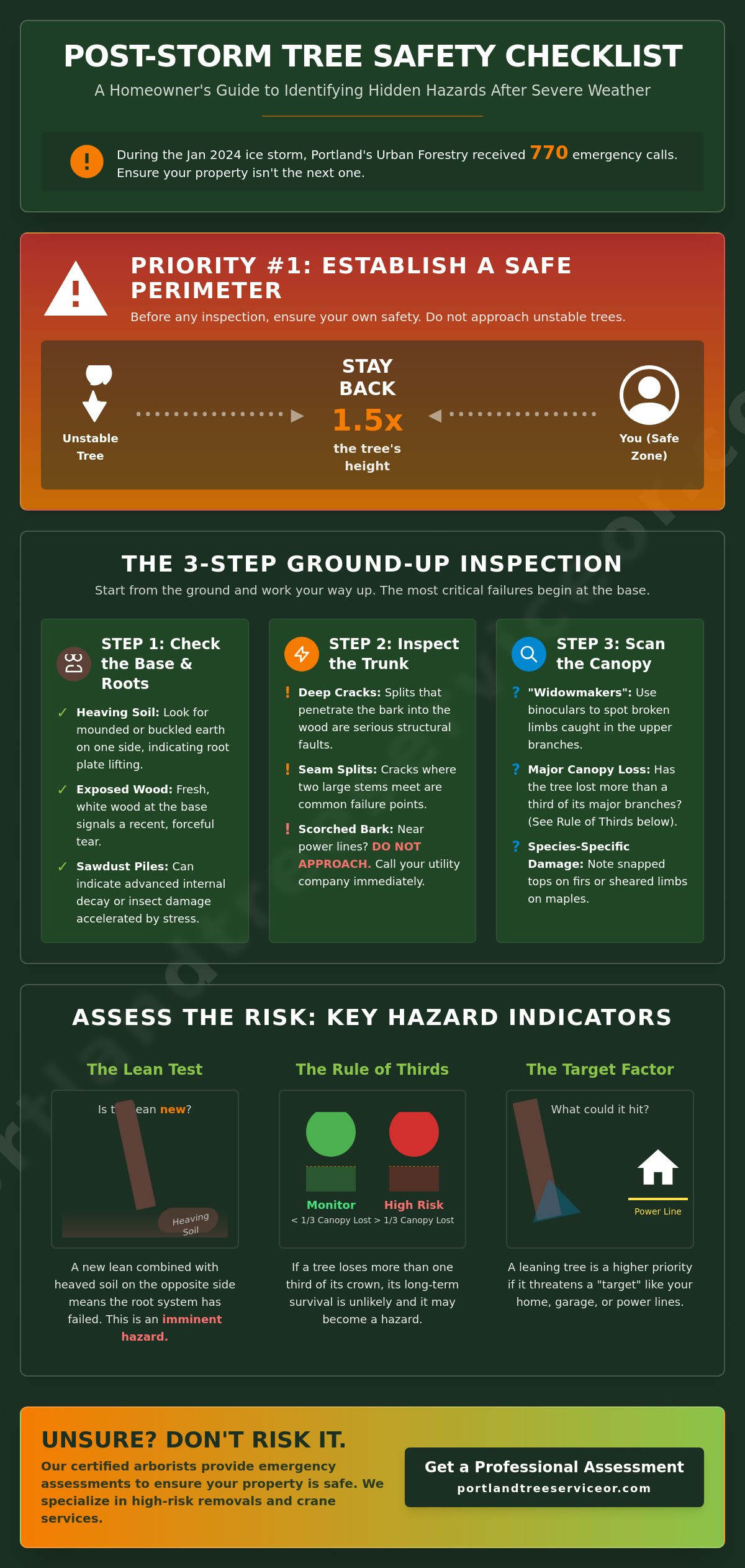
- Establish a safe perimeter by staying at least 1.5 times the height of the tree away from any specimen showing signs of instability.
- Conduct a systematic post storm tree inspection to identify subtle root plate lifting and trunk fractures that often precede a total collapse.
- Learn to spot “widowmakers” and species-specific risks, such as Douglas fir top-outs and maple limb shear, to protect your property from falling debris.
- Apply the “Rule of Thirds” to determine if a tree has lost too much canopy to survive or if it remains a candidate for long-term monitoring.
- Evaluate the “target factor” of leaning trees to prioritize professional emergency tree service for those threatening houses or power lines.
Immediate Ground-Level Safety and Visible Tree Damage Indicators
A post storm tree inspection serves as a systematic safety check performed after severe weather to identify structural compromises. Much like a windstorm mitigation inspection assesses a building’s resilience, this process evaluates whether a tree remains a safe part of your landscape. We recommend starting this process only when the weather has fully cleared and visibility is high. Taking the time to look for subtle signs of failure can prevent a hazardous situation from turning into a property-threatening emergency.
Safety is the primary metric of success during any assessment. Before you approach a tree, establish a “Safe Perimeter” by staying at least 1.5 times the height of the tree away if you suspect any instability. This distance provides a necessary buffer against unexpected trunk failure or uprooting. Keeping this distance protects you while you gather the visual data needed to decide if professional Emergency Tree Service is required. Never stand directly under the canopy of a stressed tree to take photos or notes.
Adopt a “ground-up” philosophy during your post storm tree inspection. While many homeowners look at the leaves first, the trunk and base reveal far more about a tree’s internal integrity. Look for freshly exposed white wood or large piles of sawdust, which often indicate recent structural tearing or advanced internal decay. Check for buckled soil or “heaving” at the base. Soil that has shifted or mounded on one side suggests the root plate is lifting, which makes the tree a prime candidate for immediate Tree Removal. Familiarizing yourself with the signs of a dying tree before a storm hits can help you distinguish pre-existing decline from fresh storm damage during your inspection.
Identifying Critical Trunk Splits and Vertical Cracks
Differentiating between harmless surface bark shedding and deep structural cracks is essential for property safety. Many species naturally shed bark as they grow, but a hazard crack is a split that goes through the bark into the wood fiber. Pay close attention to “seam” cracks where two trunks meet. These are primary failure points during intense Portland windstorms; they often require Crane Services to manage safely if the tree begins to fail.
Power Line Awareness and Electrical Hazards
Never approach a tree that is touching a utility line, even if the power seems to be out in your neighborhood. Saturated wood is an excellent conductor of electricity. Inspect the area from a distance for signs of arcing or scorched, blackened bark near the wires. If you see these indicators, stay back and contact the utility company immediately before seeking any professional tree-related solutions.
Evaluating the Canopy and Root Zone for Hidden Structural Failures
Once you’ve cleared the ground-level check, your post storm tree inspection must shift focus toward the upper canopy and the soil’s stability. In the Pacific Northwest, our unique climate and species diversity create specific failure patterns. Douglas firs, for instance, are notoriously prone to “top-out” failures where the upper third of the tree snaps under wind pressure. Conversely, broadleaf Maples often suffer from limb shear, losing massive branches while the main trunk remains standing. Identifying these “widowmakers,” which are broken limbs detached but caught in the canopy, is critical before they fall without warning. Storms can also accelerate the progression of existing disease, so understanding when to remove a diseased tree in Portland is an important part of evaluating whether a storm-damaged specimen was already structurally compromised before the weather event.
Determining if a tree leaning towards house structures is a new hazard or a pre-existing condition requires a “Lean Test.” Look closely at the base for root plate heaving. If you notice fresh mounding or soil lifting on the side opposite the lean, the tree has likely shifted during the storm. This structural failure often necessitates immediate Tree Removal to prevent a total collapse. If you’re unsure about the stability of a large specimen, seeking a professional arborist assessment is the safest course of action for your property.
Reading the Canopy for ‘Hung’ and Broken Limbs
Grab a pair of binoculars to scan for “hangers” that are caught on lower branches. These limbs are often under significant tension and can fail when subsequent rain or snow adds weight, a process known as “loading.” PNW species like Western red cedar or Bigleaf maple frequently hide internal rot until a storm reveals the weakness. If you spot multiple broken branches high up, it’s a sign that the tree’s structural integrity is compromised. Our team provides expert Emergency Tree Service to safely clear these high-altitude hazards before they reach the ground.
Saturated Soils and Root Stability in Portland
Portland’s heavy winter rains don’t just water the trees; they lubricate the entire root system. This saturation makes even healthy trees susceptible to wind-throw, where the entire root plate pulls out of the ground. Watch for “cracking” in the soil or mounding near the base, as these are clear indicators of a compromised foundation. For more details on maintaining long-term property safety, refer to our Tree Risk Assessment Guide to keep your canopy healthy and resilient year-round.
Deciding Between Monitoring and Professional Emergency Intervention
Deciding whether to monitor a tree or call for help is the final step of a post storm tree inspection. We use the “Rule of Thirds” as a primary guideline for structural health. If a tree has lost more than one-third of its canopy, its ability to photosynthesize and maintain balance is severely compromised. In these cases, the tree is likely a candidate for professional Tree Removal. You must also evaluate the “Target Factor.” A leaning tree in an open field is a minor concern; the same tree leaning towards house structures, power lines, or a public sidewalk is a high-priority hazard. Knowing the signs of a dying tree can also help you determine whether a storm-damaged specimen was already in decline and is unlikely to recover, making removal the more prudent long-term choice. If disease is a contributing factor, our guide on when to remove a diseased tree Portland homeowners should consider can help you weigh the risks and navigate local permit requirements before making a final decision.
When a tree has already fallen onto a structure, traditional ground-based methods are often insufficient and dangerous. This is where specialized equipment becomes essential. Utilizing a crane tree removal service allows us to lift heavy timber vertically without putting additional weight on your roof. This precision minimizes further property damage and ensures the safety of everyone on the ground. DIY storm cleanup remains the leading cause of tree-related injuries for homeowners; tension in twisted limbs can release with lethal force when cut without professional rigging.
When a ‘Wait and See’ Approach Becomes Dangerous
Structural fatigue doesn’t always result in immediate failure. Some trees survive the initial winds only to fall 48 to 72 hours later due to “delayed failure.” This happens as the wood fibers finally give way after being stretched to their limit. You should call for Emergency Tree Service immediately if you spot a tree leaning toward a structure, a fresh crack in the main trunk, or any contact with utility lines.
Documenting Damage for Insurance and Risk Mitigation
Proper documentation is vital for successful insurance claims. Take clear photos from multiple angles while staying well outside the established fall zone. We recommend hiring an ISA Certified Arborist to conduct a formal risk assessment for your post storm tree inspection. Their professional report provides the objective data insurance adjusters require to verify that a tree poses an immediate threat to your property.
Securing Your Property and Restoring Peace of Mind
Maintaining a safe landscape in the Pacific Northwest requires vigilance, especially after the volatile weather patterns we face. By performing a systematic post storm tree inspection, you can identify the critical indicators of structural failure before they result in a property-threatening emergency. Remember to prioritize ground-level stability checks and use binoculars to scan for detached limbs caught high in the canopy. These proactive steps allow you to distinguish between minor cosmetic damage and hazardous conditions that require professional intervention.
When a tree’s integrity is compromised, the risk of delayed failure or personal injury during cleanup is too high to ignore. Our team brings over 30 years of local experience to every property we serve. We utilize specialized crane equipment for low-impact hazardous removal, which protects your home from further damage. If you suspect a tree is no longer stable, we provide a 24/7 emergency response for storm-damaged properties to ensure your family’s safety and the longevity of your landscape.
Request an Emergency Post-Storm Inspection from Portland Tree Service today to secure your property. We are here to help you move forward with confidence and expert care.
Frequently Asked Questions
How do I know if my tree is leaning dangerously after a storm?
Look for fresh soil heaving or exposed roots on the side opposite the lean. A new lean accompanied by cracked earth indicates the root plate has shifted, which creates an immediate risk of failure. Pre-existing leans often have curved trunks as the tree corrected its growth over time, whereas storm-induced leans are characterized by straight trunks and disturbed ground at the base.
Can a tree survive a vertical crack in its trunk?
Survival depends on the depth and location of the crack. A hazard crack that penetrates through the bark into the internal wood fibers often indicates a catastrophic structural failure. While some trees can be stabilized, a deep vertical split usually compromises the tree’s ability to support its own weight. This makes the tree a candidate for professional removal to protect your property from a total collapse.
What should I do if a large limb is hanging high in my tree?
Stay clear of the area and establish a safe perimeter immediately. These “widowmakers” are detached branches caught in the canopy that can fall at any moment without warning. Because these limbs are often under tension or precariously balanced, they require specialized rigging or crane services to be removed safely without causing further damage to the tree or structures below.
Is it safe to trim storm-damaged branches myself?
Trimming major storm damage is rarely safe for homeowners due to the unpredictable nature of “loaded” branches. Wood under tension can snap back with immense force when cut, leading to severe injury. Professional crews use calibrated safety gear and methodical cutting techniques to manage these risks. It is best to limit DIY efforts to small debris already on the ground and leave canopy work to experts.
How much does a post-storm tree inspection cost in Portland?
The cost of a professional assessment varies based on the size of your property and the number of trees requiring evaluation. A detailed post storm tree inspection is a strategic investment that identifies hidden hazards before they escalate into costly emergencies. This service provides the technical data needed to determine if a tree is safe or if it requires specialized intervention to protect your home’s value.
Does homeowners insurance cover the cost of a post-storm tree inspection?
Insurance coverage varies, but most policies only pay for removal if a tree has already fallen on a covered structure like your home or fence. Some carriers may cover a post storm tree inspection if it is deemed necessary to prevent imminent damage to the property. You should review your specific policy or speak with your agent to determine if preventative assessments are included in your storm recovery coverage.