Could a single mistake in calculating a tree’s center of gravity cost you your entire roof? Many property owners feel a genuine sense of anxiety when a dead or leaning tree looms over their home. It’s natural to worry about a heavy trunk crashing through the shingles or a worker getting injured on your land. You deserve to know that safe tree removal isn’t just about a chainsaw and a ladder. It is a complex engineering project that relies on physics and specialized machinery to eliminate gravity-based risks.
We understand that you want your landscape protected and your family kept out of harm’s way. This guide explains the rigorous safety protocols and technical standards that distinguish a master craftsman from a dangerous DIY attempt. You’ll learn about the impact of the updated ANSI Z133-2026 standards and how professional rigging prevents property damage. We will also preview how specialized equipment like cranes allow crews to remove hazardous trees with surgical precision, giving you total peace of mind that your property is in expert hands.
In This Guide:
- Master the physics of tension and compression to understand why safe tree removal is a matter of precision engineering rather than brute force.
- Explore how crane-assisted removals protect your landscape by lifting heavy sections vertically and eliminating the dangerous felling zone.
- Recognize the synchronized efforts of climbers and operators that ensure a controlled, predictable outcome for every complex project.
- Use our on-site checklist to verify essential insurance and safety gear before any work begins on your property.
- Gain peace of mind by knowing exactly which professional standards separate expert veterans from high-risk amateurs.
The Physics of Danger: Why Safe Tree Removal Requires Precision
Safe tree removal is fundamentally the practice of controlled dismantling. It is a specialized branch of Arboriculture that treats every limb and trunk section as a calculated load. Instead of letting gravity dictate the outcome, professionals use physics to negate it. We view a tree not as a single object, but as a complex system of stored energy that must be released in a predictable sequence.
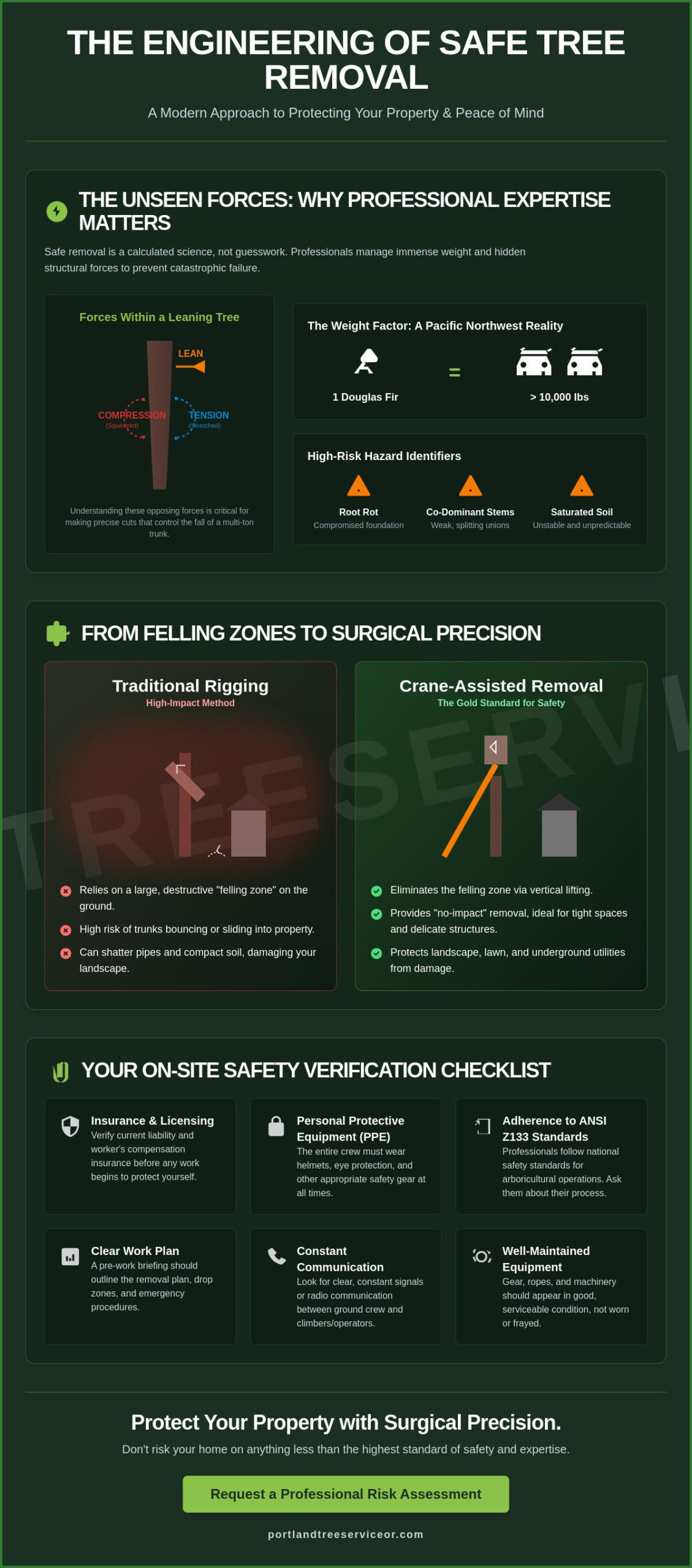
Every leaning or damaged trunk contains hidden forces. On the side of the lean, the wood is under “compression,” squeezed tight by the tree’s massive weight. On the opposite side, the wood is under “tension,” stretched like a heavy-duty cable. Professionals manage these forces through precise “hinge wood” mechanics. A DIY attempt often fails because the cutter doesn’t understand how a thin strip of wood steers a falling trunk. Without this control, a tree can “chair” or kick back with lethal force. This is why a comprehensive tree risk assessment is mandatory before the first cut is made. This evaluation identifies structural weaknesses that aren’t visible to the untrained eye.
The Weight Factor in the Pacific Northwest
A mature Douglas fir is a massive structural load. These giants can weigh over 10,000 pounds; that’s more than two heavy-duty pickup trucks. Specialized rigging and high-strength ropes are required to move that mass safely. In Oregon, our weather adds another layer of risk. Saturated soil from winter rains and sudden high winds can shift a tree’s center of gravity in hours. This makes safe tree removal a moving target that requires constant adjustment during the operation.
Identifying High-Risk Scenarios
We look for specific markers of “hazard trees,” such as co-dominant stems or signs of root rot. These issues are particularly common near the shorelines of Lake Oswego or West Linn. The loose, moist soil in these regional municipalities often compromises root stability. When a tree’s foundation is soft, the entire removal process must be re-engineered. We must prevent the trunk from uprooting or shifting unexpectedly while a climber is still in the canopy. Expert crews account for these soil conditions to ensure your property remains undamaged.
Specialized Equipment: How Cranes Redefine Safety
Traditional tree work often relies on “rope and saddle” rigging. While effective, it still requires a designated “felling zone” where debris must land. A crane tree removal service changes this dynamic entirely by introducing vertical lifting. By hoisting sections straight up and away, we eliminate the risk of a trunk bouncing or sliding into your siding. This is the gold standard for safe tree removal on properties with tight boundaries or delicate structures.
This process is a synchronized dance between two specialists. The climber secures the rigging in the canopy, while the crane operator manages the weight from the ground. They use wireless communication to ensure every cut is supported before it’s made. This method ensures “no-impact” removal, which is essential for homes in densely packed neighborhoods. It removes the guesswork that comes with manual felling.
Precision Rigging and Sectional Removal
Trees are dismantled in specific “picks,” or sections, that are calculated to maintain the crane’s balance. We use specialized slings and shackles rated for high-tonnage loads to secure these pieces. Following Tree Care Industry Association safety standards ensures that every piece of equipment is inspected and capable of handling the massive forces involved. If you’re facing a hazardous situation, our crane-assisted expertise provides a level of control that manual rigging simply cannot match.
Protecting the Portland Landscape
Heavy trunks dropping from 60 feet can shatter underground pipes or compact your soil. Cranes bypass this damage by flying the wood to a safe landing zone. This level of care also makes subsequent tree root removal Portland projects much cleaner. When the main weight is lifted away rather than slammed into the earth, the root structure remains stable and easier to manage without destroying your lawn’s aesthetics.
Vetting for Safety: A Homeowner’s On-Site Checklist
Hiring a crew for safe tree removal involves more than just checking a license number. It’s about verifying that the team on your lawn follows the rigorous ANSI A300 standards for tree care operations. Professionalism starts with high-risk insurance coverage. You must confirm the company carries both General Liability and Workers’ Compensation. Without Workers’ Comp, you as the property owner could be held liable if a worker is injured on your land. A master craftsman won’t hesitate to provide these certificates; they’re a primary seal of authenticity for any veteran business.
Before the first saw starts, watch for a Job Site Safety Briefing. This is where the crew discusses the drop zone, identifies overhead hazards, and confirms communication signals. Observe their gear. Every member should wear Personal Protective Equipment (PPE), including high-visibility clothing, hard hats, and chainsaw chaps. If a crew arrives in t-shirts and baseball caps, it’s a major red flag. Expert teams also prioritize ISA certifications, which prove they’ve mastered the latest techniques in arboriculture and risk management.
Portland Permit and Regulatory Safety
Following City of Portland permit laws is a safety requirement, not just a legal one. Our local Urban Forestry regulations ensure that removals don’t compromise the stability of the surrounding canopy or the health of the local ecosystem. A professional crew handles these regulations to ensure the work is performed within the bounds of city safety codes. This protects you from the heavy fines and property instability that often follow unpermitted, amateur removals.
Questions to Ask Your Estimator
Use these three specific questions to gauge a company’s commitment to property protection:
- “What is your specific plan to protect my siding, lawn, and underground utilities from impact?”
- “Will you be using a Job Site Safety Briefing with the entire crew before work begins?”
- “Which ISA-certified professional is overseeing the safety protocols for this project?”
Identify red flags early. A lack of safety cones, outdated climbing ropes, or the absence of specialized rigging equipment suggests a company that values speed over security. Before committing to any contractor, make sure you know how to get a quote for tree removal that is transparent, fixed, and accounts for all local permit requirements. Choosing a crew that respects these details ensures your landscape is left in better condition than they found it.
Secure Your Property with Expert Engineering
Removing a hazardous tree is a high-stakes operation that demands more than just a chainsaw. You now understand that safe tree removal is a disciplined engineering process that uses physics and specialized machinery to protect your home. By choosing crews that prioritize ANSI standards and utilize crane-assisted lifting, you eliminate the unpredictable “drop zones” that threaten your landscape. This methodical approach ensures that gravity works for the crew, not against your roofline.
Our team brings over 30 years of experience to every high-risk removal in the Pacific Northwest. We utilize specialized crane equipment to provide zero-impact service, ensuring your lawn and structures remain pristine. We’re fully licensed, bonded, and insured to give you complete protection throughout the project. It’s our mission to handle the heavy lifting so you don’t have to worry about property damage or workplace accidents.
Don’t let a leaning or damaged tree cause unnecessary stress. Request a Safe Tree Removal Estimate from Our Portland Experts today and see the difference that veteran expertise makes. We are ready to restore the safety and beauty of your property with the precision it deserves.
Frequently Asked Questions
Is it ever safe to remove a tree myself?
DIY tree removal is rarely advisable for anything larger than a small sapling. The technical complexity and physical weight of mature trees create a high-risk environment that requires specialized training and equipment. Without professional rigging and an understanding of tension forces, you risk severe injury or catastrophic damage to your home. Professionals spend decades mastering safe tree removal techniques to handle these variables predictably and protect your property.
How do professionals ensure a tree falls in the right direction?
Experts use a combination of precision notch cutting and directional rigging to steer a tree’s path. By creating a specific hinge of wood between the face cut and the back cut, we guide the trunk to a designated landing zone. In tight residential spaces, we often utilize crane services to lift sections vertically. This method removes the need for a traditional felling path entirely and ensures the wood never makes contact with your structures.
What is the safest time of year for tree removal in Portland?
The dormant winter season is often the safest and most efficient time for planned removals. Trees are lighter without their summer foliage, and the lack of leaves provides better visibility for the crew. While Portland’s saturated winter soils can create stability challenges, our master craftsmen evaluate each site’s specific ground conditions before beginning. If a tree shows signs of failure, our emergency tree service addresses the hazard immediately to prevent storm-related damage, following the same rigorous safety protocols used for emergency tree removal Austin TX when handling hazardous or fallen trunks.
Does insurance cover damage caused during a professional tree removal?
A professional company’s General Liability insurance covers property damage that might occur during the project. This is why verifying a contractor’s insurance certificates is a critical step in your vetting process. When you hire an insured veteran, their policy acts as a financial shield for your home and landscape. It provides total peace of mind that you won’t be held responsible for accidents or structural impacts during the removal process. To ensure you’re working with a fully compliant contractor from the start, learn how to get a quote for tree removal in Portland that includes verified insurance documentation and 2026 regulatory compliance.