Imagine lying awake during a midnight windstorm in Portland, listening to the wind howl through the Douglas firs and wondering if that creak you heard was just a branch or a trunk about to give way. It’s a common fear for local homeowners who live among the city’s four million trees. Identifying the specific signs of a dying tree early can be the difference between a routine maintenance task and a costly emergency after a structural failure.
You shouldn’t have to guess whether a sudden needle drop is a seasonal shift or a symptom of a deep-rooted disease. We understand the anxiety that comes with managing large-scale timber on a residential lot. This guide provides the clarity you need to assess your property’s safety with confidence. You’ll learn how to spot critical warning signs before the next major storm hits the Willamette Valley. We will provide a professional “stay or go” framework that covers bark health, canopy density, and root integrity so you can make an informed decision for your home.
Key Takeaways
- Perform the cambium scratch test to verify living tissue and avoid the unnecessary removal of a healthy tree.
- Identify the critical signs of a dying tree to differentiate between harmless seasonal needle drop and hazardous internal decay.
- Utilize the “Target Rule” to calculate the potential impact zone, helping you prioritize the protection of your home and utility lines.
- Evaluate large trees within 20 feet of your house to mitigate the risk of property damage during the next Pacific Northwest windstorm.
7 Critical Signs of a Dying Tree: Your Visual Inspection Checklist
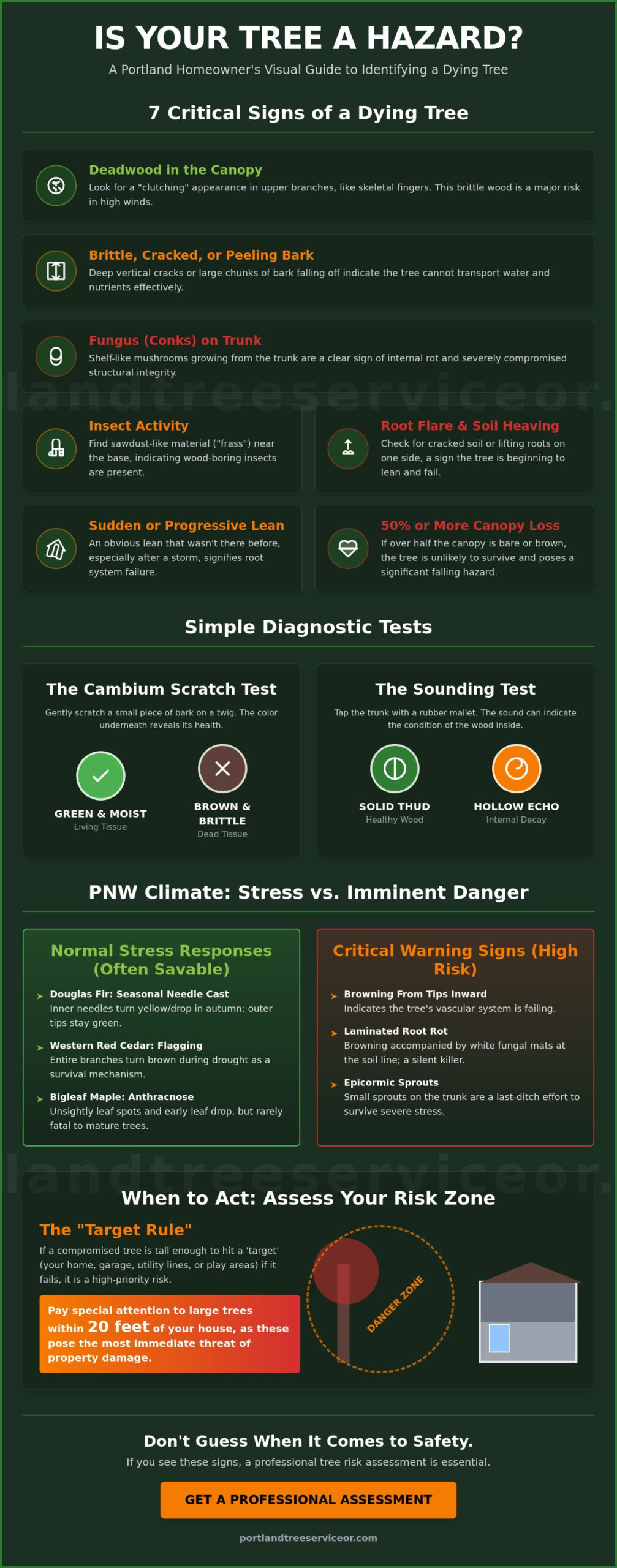
Visual inspection is your first line of defense against property damage. Identifying the specific signs of a dying tree requires a methodical approach, starting from the canopy and moving down to the root flare. In the Pacific Northwest, environmental stressors can lead to Forest dieback, a condition where large sections of a tree’s crown begin to fail. You should look for a “clutching” appearance in the upper branches, where the lack of foliage makes the limbs look like skeletal fingers reaching upward. This deadwood is brittle and poses a significant risk during high winds.
Performing the Scratch Test Safely
The scratch test is a reliable way to check the cambium layer, which is the living tissue just beneath the bark. Use a small pocketknife or your fingernail to peel away a tiny sliver of bark on several different branches. A healthy tree will show a green, moist layer underneath. If the tissue is brown and brittle, that specific area is dead. If you find that the trunk remains brown while the outer branches are green, the tree may still be salvageable with professional intervention.
Brittle Bark and Fungal Growth
Healthy bark should be continuous and firm. When you see deep, vertical cracks or large chunks of bark falling away, it often indicates a loss of vascular health. This prevents the tree from transporting water and nutrients effectively. You should also inspect the base for conks, which are shelf-like mushrooms growing from the trunk. These fungi are clear indicators of internal rot, meaning the heartwood is decaying and the structural integrity of the tree is compromised.
Root Flare and Soil Heaving
The area where the trunk meets the soil is called the root flare. Check this zone for “frass,” a sawdust-like material left behind by wood-boring insects. You should also look for cracked soil or roots that appear to be lifting on one side. This soil heaving suggests the tree is beginning to lean, which often precedes a total failure during an Oregon rainstorm. If you notice these symptoms in a large Douglas fir or Western Red Cedar, the risk level for your property has increased significantly.
Diagnosing Tree Stress vs. Death in the Portland Climate
Portland’s unique climate creates specific visual cues that often confuse property owners. Distinguishing between a temporary stress response and the actual signs of a dying tree is vital for maintaining a safe landscape. For example, Douglas firs undergo “seasonal needle cast” every autumn. You might see inner needles turn yellow and drop. This is a natural process. If the outer tips of the branches remain green and vibrant, your tree is likely healthy. Conversely, if the browning starts at the tips and moves inward, the tree’s vascular system is likely failing.
Western Red Cedars in the Willamette Valley frequently suffer from drought stress during our increasingly dry summers. You will notice “flagging,” where entire branches turn brown. While this looks alarming, it is often a survival mechanism. However, if the browning is accompanied by white fungal mats near the soil line, you may be dealing with Laminated Root Rot. This is a silent killer common in Lake Oswego and West Linn that compromises the root system long before the canopy dies. Identifying these hidden hazards after an Oregon storm is critical for property safety.
Common PNW Tree Diseases to Watch For
Anthracnose is another common local issue, particularly for Bigleaf Maples. It causes unsightly leaf spots and premature leaf drop. While it looks terminal, it rarely kills a mature tree on its own. You can also use the “sounding” method to check for internal health. Use a rubber mallet to tap the trunk at various heights. A solid, dull thud indicates healthy wood. A hollow echo suggests internal decay or a cavity, which increases the risk of a sudden fall. Understanding when to remove a diseased tree in Portland is essential once you’ve identified these warning signs in your Pacific Northwest landscape.
When a Stressed Tree Can Be Saved
Not every stressed tree requires removal. If you spot epicormic sprouting, which are small “water sprouts” growing directly out of the main trunk, the tree is making a last-ditch effort to survive. Professional structural pruning and deep-root fertilization can sometimes reverse this decline if caught early. Before you decide to cut, a professional tree risk assessment is essential to determine if the specimen is a candidate for preservation or a necessary removal candidate.
When to Remove a Dying Tree: Safety and Prevention
Once you identify the primary signs of a dying tree, the focus shifts from diagnosis to risk management. In the Pacific Northwest, a compromised tree is a structural liability. We use the “Target Rule” to assess the level of danger. A target is any person or object that could be harmed or damaged if the tree fails. If your tree is positioned to hit a house, power lines, or a neighbor’s property, the urgency for removal increases. Waiting until the first winter gale hits the Willamette Valley often leads to emergency situations that are more dangerous and costly than planned maintenance.
Proximity is another critical factor. Any large tree within 20 feet of a structure requires an immediate professional evaluation. Root systems often intermingle with foundations or utility lines, making traditional felling impossible. For these high-risk scenarios, we utilize specialized equipment to ensure the protection of your property. Using a crane allows us to lift sections vertically, eliminating the “drop zone” entirely. This methodical approach minimizes the impact on your lawn and surrounding landscaping.
Why High-Risk Trees Require Crane Services
For tight Portland backyards, a professional crane tree removal service is the gold standard for safety. Our team uses heavy machinery to secure and lift massive limbs over the roofline, preventing any contact with the house. This precision-based work is essential when dealing with unstable timber that cannot support the weight of a climber. It removes the guesswork and ensures a controlled, safe environment for both our crew and your home.
Your Immediate Action Plan
- Step 1: Document the decay or damage with clear photos. This documentation is helpful for insurance claims or local permit applications.
- Step 2: Check for a tree leaning towards house. A lean combined with root heaving indicates an imminent threat during high winds.
- Step 3: Contact a veteran arborist to provide a technical removal estimate. Early intervention prevents the stress of an emergency failure during an Oregon storm.
Securing Your Property Before the Next Storm
Protecting your Portland home starts with a proactive approach to landscape safety. You’ve learned how to identify the critical signs of a dying tree, from root heaving and fungal conks to the “target rule” for assessing risk. It’s vital to remember that early detection prevents the high costs and physical dangers of a sudden structural failure during an Oregon windstorm. Don’t leave your property’s safety to chance when the seasons change.
We bring over 30 years of local tree care experience to every neighborhood in the metro area. Our crew utilizes specialized crane equipment to perform zero-impact removals, ensuring your home and landscaping remain untouched during the process. We’re fully licensed, bonded, and insured for high-risk extractions, providing the expert reliability you need for large-scale timber management. Request a Professional Tree Risk Assessment and Removal Estimate to get a definitive answer on your tree’s health. Taking this step now ensures your canopy remains a beautiful asset rather than a structural liability.
Frequently Asked Questions
Is a tree dead if it has no leaves in winter?
Deciduous trees naturally shed their leaves and enter a state of dormancy to survive the cold months in the Pacific Northwest. This is a healthy biological process and doesn’t indicate a problem. You can confirm the tree’s health by checking the tips of the branches for flexible, living buds that will bloom in the spring. If the branches are brittle and snap easily, you should perform a scratch test to check for green tissue beneath the bark.
Can a dying tree be brought back to life?
Recovery is possible if the tree is experiencing temporary environmental stress rather than total systemic failure. If you identify the signs of a dying tree early, such as minor canopy thinning or drought stress, professional soil treatments or structural pruning can often stabilize the specimen. However, once internal rot or significant root loss occurs, the tree’s structural integrity is compromised beyond repair. At that stage, removal is the only responsible way to protect your property from a sudden collapse.
How long does it take for a dead tree to fall?
The timeline for a tree failure is unpredictable and depends heavily on the species and the local weather conditions. A Douglas fir with advanced root rot might stand for months only to fail during the first heavy rain of the season. Wood fibers lose their elasticity and strength quickly once the tree dies, making the structure increasingly unstable. You shouldn’t wait for a storm to test the strength of dead timber, as the risk of property damage increases every day the tree remains standing.
What happens if a dead tree on my property falls on my neighbor’s house?
You may be held legally and financially liable for damages if the tree was a known hazard that you failed to address. Insurance companies often categorize these incidents as negligence rather than an “act of God” if the tree showed visible signs of decay before the fall. Maintaining your canopy isn’t just about aesthetics; it’s a critical part of being a responsible property owner in a densely populated area like Portland. Addressing hazardous trees promptly protects your assets and your relationships with those living around you.
How much does it cost to remove a large dying tree in Portland?
The cost of removal depends on the size of the tree, its health, and its proximity to your home or power lines. Complex jobs in tight residential spaces often require specialized crane services to ensure a zero-impact extraction. These factors influence the technical difficulty and the time required to complete the work safely. You should request a professional estimate to understand the specific requirements for your property, especially if the tree is in a location that’s difficult to access with traditional equipment.