Imagine lying awake during a midnight Oregon storm, listening to the wind howl and the rhythmic thud of a heavy Douglas fir limb striking your roof. You know it’s only a matter of time before gravity wins, and the fear of a branch crashing through the ceiling makes sleep impossible. You’re right to be concerned. In our region, a hazardous limb isn’t just a threat to your home’s structure; it’s a liability that requires immediate, professional attention to avoid catastrophic damage. When a situation becomes critical, emergency tree limb removal is the most effective way to secure your property before the next gust of wind turns a threat into a disaster.
We understand the stress of watching a massive branch hang precariously over your bedroom. This guide will teach you how to identify urgent limb hazards and why specialized crane-assisted removal is the safest method to protect your roof and family. We’ll also provide clarity on navigating Portland’s Title 11 Tree Code and the insurance claims process. You’ll learn how to mitigate risks rapidly while ensuring zero secondary damage to your lawn or home through the precision of master craftsmanship.
Key Takeaways
- Identify “widow-makers” and structural failures early to trigger emergency tree limb removal before heavy branches impact your roof.
- Utilize crane-assisted extraction to achieve zero-impact results that protect your lawn and home from the risks of traditional rigging.
- Navigate the insurance claim process effectively by understanding your policy’s “Mitigation of Damages” requirements for hazardous trees.
- Learn the logistical steps of a professional dispatch process to ensure a rapid response when an Oregon storm compromises your property’s safety.
Recognizing a Tree Limb Emergency: When to Call the Pros
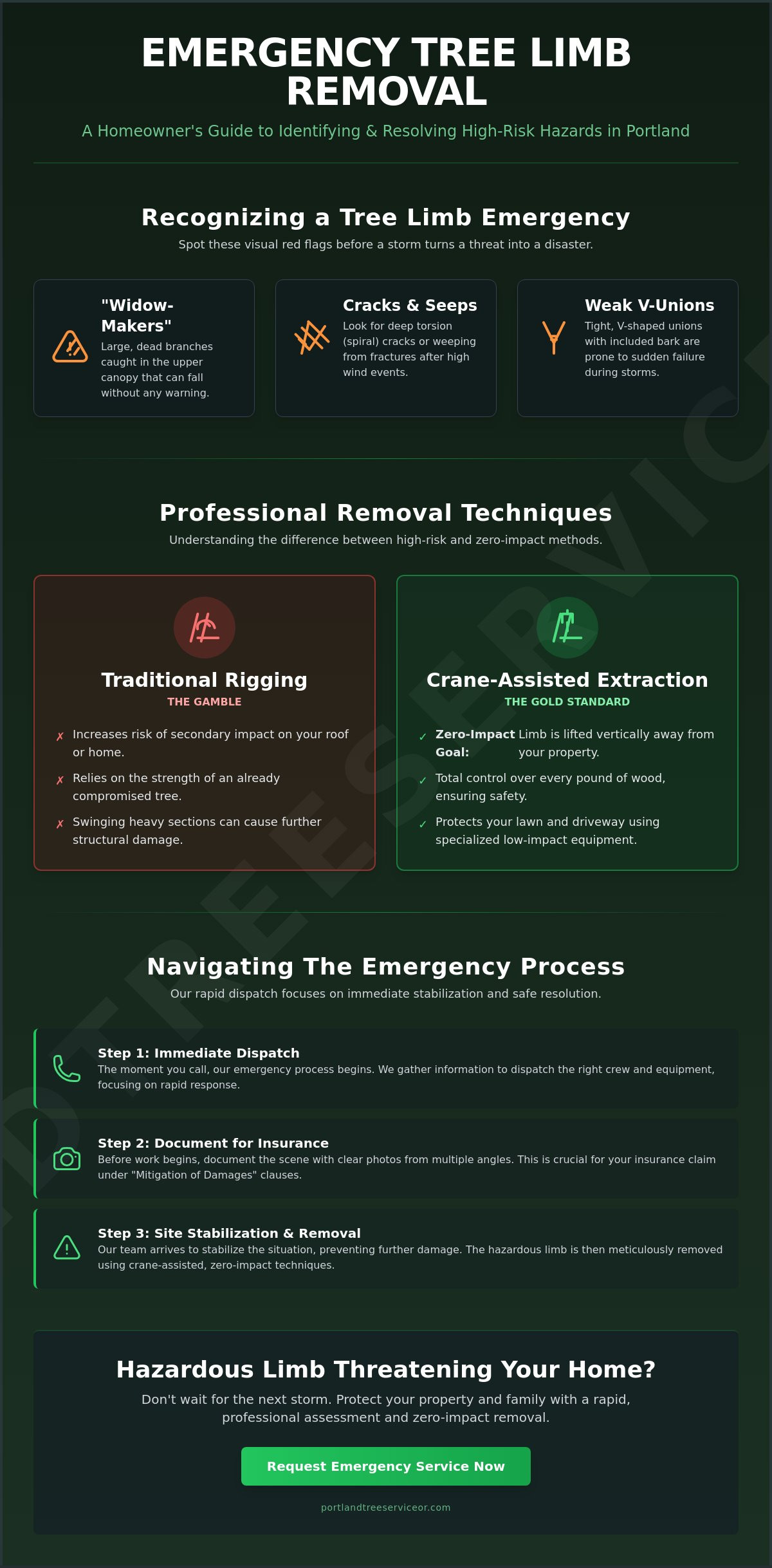
An emergency limb hazard exists whenever a large branch exhibits structural failure while positioned over a “target,” such as your roof, driveway, or power lines. In the Pacific Northwest, we frequently deal with “widow-makers.” These are large dead branches caught in the upper canopy that can fall without warning, even on a calm day. Identifying these risks requires a professional tree risk assessment to ensure your property remains safe during our unpredictable seasons.
Portland’s weather patterns create unique stresses for our urban forest. Heavy ice loads from winter storms often overwhelm the lateral limbs of Douglas fir and Western Red Cedar trees. This weight frequently results in a hanging hazard, which is a limb that has detached from the trunk but remains precariously supported by other branches. When these heavy pieces of wood lose their structural integrity, immediate emergency tree limb removal becomes the only way to prevent a secondary impact on your home.
Visual Red Flags: Cracks, Seeps, and Hanging Wood
You can often spot danger before it falls. Look for torsion cracks, which are spiraling fractures that appear after high wind events in the Willamette Valley. Another critical warning sign is included bark. This occurs in tight, V-shaped limb unions where bark grows inward rather than knitting together, leading to sudden failure during storms. While a dead branch might only need a routine trim, a limb with deep cracks or one that has shifted position over your house makes emergency tree limb removal a top priority. If you’re also concerned about the overall stability of the tree itself, our hazardous tree removal step-by-step guide can help you identify whether the entire structure poses a risk to your property.
Limbs Near Utilities and Public Rights-of-Way
Safety is our primary metric, so you should never attempt to handle a limb in contact with power lines. If a branch touches a line, contact PGE or Pacific Power immediately. Additionally, Portland homeowners are responsible for managing limbs that overhang city sidewalks or streets. If a hazardous branch threatens a public right-of-way, it’s your responsibility to address it before it causes injury or property damage to others. Taking proactive steps ensures you meet your legal duty of care as a property owner.
Professional Removal Techniques: Why Crane Assistance is the Gold Standard
Traditional “rope and saddle” rigging relies on the tree itself to support the weight of falling wood. This method often involves swinging heavy sections, which increases the risk of a secondary impact on your roof. By contrast, specialized crane-assisted extraction allows us to lift hazardous limbs vertically away from the structure. This “zero-impact” goal ensures that once a limb is cut, it never touches your shingles or gutters. It’s the most reliable way to manage a high-risk situation without gambling on the strength of a compromised trunk.
The Mechanics of a Crane “Pick” for Hazardous Limbs
During a high-risk extraction, an arborist secures the limb to the crane hook with precision rigging before the final cut is made. This synergy between the climber and the crane operator allows for total control over every pound of wood. A crane eliminates the dynamic load risk to the tree trunk during removal, preventing the “snap-back” effect that often causes further structural damage to weakened trees. This level of technical precision is why we recommend a Professional Crane Tree Removal Service in Portland: 30+ Years of Safety for complex hazards.
Low-Impact Equipment for Portland Landscaping
Many homeowners worry that heavy machinery will destroy their lawn or crack their driveway. We utilize specialized equipment designed to operate from the street or driveway, reaching over the house to access backyard trees that bucket trucks simply cannot reach. To protect high-end surfaces in Lake Oswego and West Linn, we use protective mats and specialized stabilizers that distribute weight evenly. This thoughtful approach ensures your emergency tree limb removal is completed without leaving a trace on your landscape. Safety for the ground crew and the preservation of your remaining tree structure are our primary metrics for success. If you’re concerned about a precarious branch, choosing a team with specialized crane capabilities is the safest path forward.
Navigating the Emergency Process: Insurance and Local Logistics
When a storm strikes, the clock starts ticking on your property’s safety. Our dispatch process begins the moment you call, moving quickly from the initial assessment to the arrival of a specialized crane crew. We focus on immediate stabilization to prevent a precarious situation from becoming a total loss. Before our team makes the first cut, you should document the scene with clear photos from multiple angles. This visual evidence provides adjusters with the proof they need to see the exact state of the hazard before it was mitigated.
Most homeowner policies contain a “Mitigation of Damages” clause. This provision essentially requires you to take reasonable steps to protect your home from further harm. There is a critical distinction between clearing fallen debris and performing emergency tree limb removal for a branch that is about to fall. Insurance providers often view the removal of a hanging limb as a necessary preventative measure to save the underlying structure. Taking action now fulfills your responsibility to the insurer while protecting your family from a midnight roof collapse. Understanding the full scope of what constitutes a structural liability — from a single failing limb to an entire leaning trunk — is covered in detail in our guide to hazardous tree removal safety and prevention.
Insurance Claims for Emergency Limb Removal
Working with adjusters requires clear communication regarding the “imminent threat” to your home. If a heavy limb hasn’t caused a loss yet but is structurally compromised, it qualifies as a hazard that needs expert intervention. It’s vital to hire a company that carries comprehensive liability and workers’ comp insurance to protect you from any secondary legal or financial risks. For a deeper look at navigating these complexities, read our Tree Removal Insurance Claims: A Homeowner’s Guide to Coverage in Portland.
Portland Emergency Permit Exemptions
The City of Portland recognizes that some trees cannot wait for a standard permit cycle. Under Title 11 regulations, “Retroactive Permits” are applicable when a tree or limb poses an immediate danger to life or property. Our team manages the necessary arborist reports and documentation to ensure your emergency tree limb removal stays in full compliance with local codes. We take pride in handling the paperwork so you can focus on your home’s recovery. You can find more information on local requirements in our Tree Risk Assessment Guide: Protecting Your Portland Property and Canopy.
Secure Your Property Before the Next Storm
Facing a hazardous branch doesn’t have to be a source of constant anxiety for your family. By recognizing the early signs of structural failure and understanding the “zero-impact” benefits of crane-assisted extraction, you can protect your home’s roof with total confidence. Professional emergency tree limb removal transforms a precarious threat into a controlled, technical operation that preserves your landscape’s longevity and your home’s structural integrity. You’ve learned that acting quickly not only satisfies insurance requirements but also prevents the “secondary impact” damage common with less precise methods.
Our team brings 30+ years of experience handling hazardous PNW extractions to every job site in the Portland metro area. We utilize a specialized crane fleet specifically designed for residential removals where space is tight and the stakes are high. We are fully licensed, bonded, and insured for these high-risk operations, providing you with the peace of mind that comes from hiring seasoned veterans. Call Portland Tree Service Now for 24/7 Emergency Limb Removal to restore safety and order to your property. You don’t have to weather the next storm alone when expert help is ready to assist you.
Frequently Asked Questions
Does homeowners insurance cover the cost of emergency tree limb removal?
Homeowner’s insurance typically covers removal if a limb falls and damages an insured structure like your roof or garage. If the limb is still hanging but poses an imminent threat, many insurers cover the cost under a “Mitigation of Damages” clause to prevent a more expensive claim. You should always contact your agent to verify your specific coverage and document the hazard with photos before the crew starts work.
How much does it cost to remove a large hanging limb in Portland?
The cost to remove a large hanging limb depends on several factors, including the size of the branch and its proximity to your home. Specialized equipment like cranes or high-reach buckets can influence the final estimate, especially during a storm event. Because every situation is unique, we provide a professional assessment to determine the safest and most efficient extraction method for your specific property.
Can I wait until the storm passes to remove a cracked branch?
Waiting for a storm to subside is often a high-risk gamble that leads to secondary property damage. A cracked branch has already lost its structural integrity and can fail completely with the next gust of wind or heavy rain. Securing emergency tree limb removal as soon as you spot a fracture is the only way to ensure the branch doesn’t crash through your ceiling at night.
What should I do if a tree limb falls on power lines near my house?
You must stay away from the area and call PGE or Pacific Power immediately to report the hazard. Never attempt to clear a limb that is in contact with utility lines, as the wood and surrounding ground can become energized and life-threatening. Once the utility company has safely cleared the electrical hazard, a professional tree crew can move in to remove the remaining debris and stabilize the tree.
How do I know if a leaning limb is an immediate emergency?
A leaning limb is an immediate emergency if it shows fresh “torsion cracks,” seeping sap, or has visibly shifted its position over a target like your driveway or roof. Look for “widow-makers” caught in the upper canopy or limbs with included bark that are pulling away from the main trunk. These signs indicate that the limb’s internal structure has failed and it’s no longer self-supporting.
Will a crane damage my driveway or lawn during the removal process?
No, a professional crew uses specialized equipment and protective measures to ensure zero-impact on your landscape. We utilize heavy-duty stabilizer mats and outrigger pads to distribute the weight of the crane evenly across your driveway or street. This thoughtful approach allows us to perform emergency tree limb removal with technical precision without tearing up your lawn or cracking your pavement.