
You wake up after a Portland windstorm to find a massive Douglas fir leaning precariously toward your roof or a power line. The immediate fear isn’t just the physical danger; it’s the high deductible anxiety and the looming threat of a denied tree removal insurance claim. You’re likely asking the same question every homeowner faces in this moment: will my policy actually pay for this, or am I stuck with the bill because of perceived negligence?
We know how much you value your property and the safety of your neighborhood. Dealing with insurance adjusters while a hazard looms over your home is a burden no one wants. This guide will show you exactly when insurance covers tree removal and how to document the damage to ensure your Portland property remains protected. We’ll walk through the specific “covered perils” that trigger a payout, the 2026 Portland permit updates you must follow, and the exact steps to prove a storm caused the hazard rather than long-term neglect.
Key Takeaways
- Identify the specific “covered perils,” such as Portland windstorms or ice, that trigger your homeowner’s policy to pay for hazard removal.
- Learn how to document a tree removal insurance claim correctly by capturing the right evidence of storm damage before any work begins.
- Understand the “Structure Rule” to see why insurance typically requires a tree to hit an insured building or fence before covering extraction costs.
- Protect your property value by using specialized crane services to remove fallen timber without causing additional, uninsured secondary damage.
- Discover how to avoid claim denials by proving a hazard resulted from a sudden storm rather than long-term tree neglect.
Does Homeowners Insurance Cover Tree Removal in Portland?
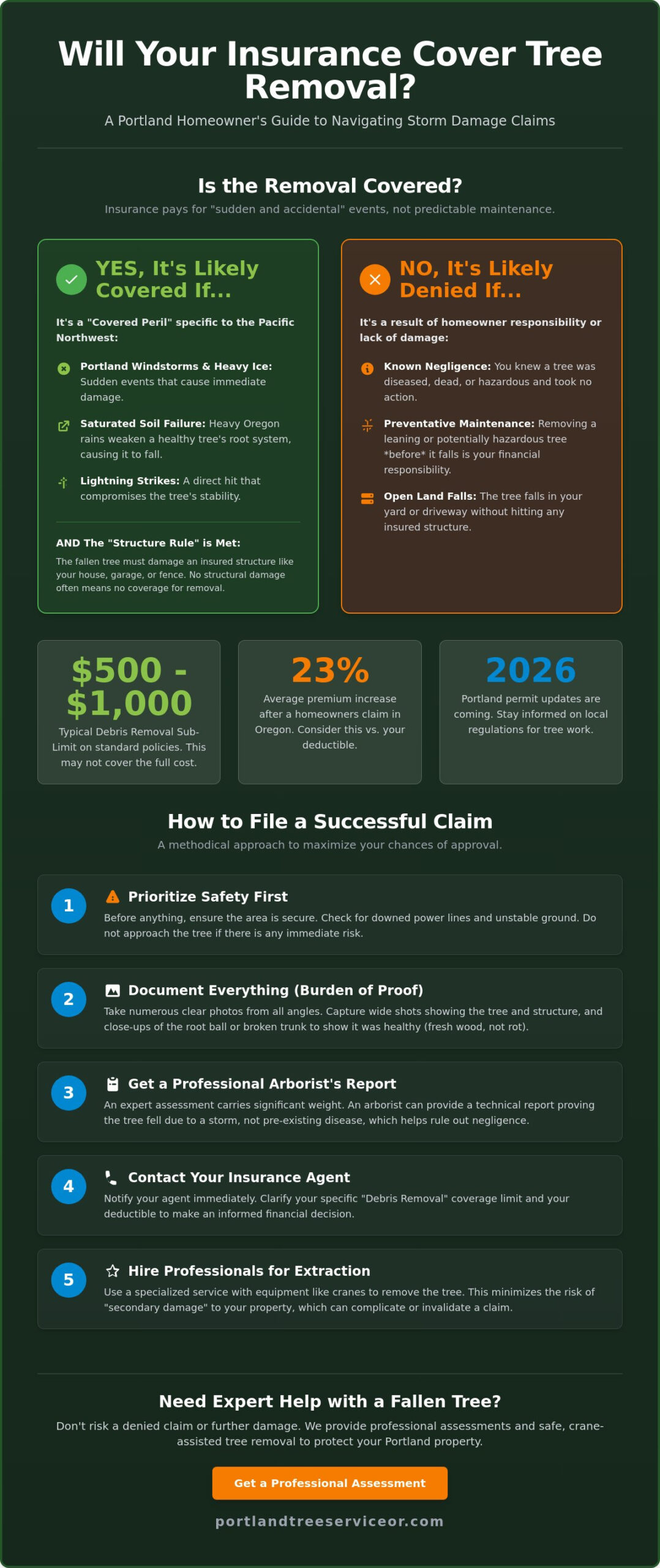
A successful tree removal insurance claim usually hinges on one specific phrase: sudden and accidental. Insurance is designed to protect you from unpredictable events, not from the natural aging process of your landscape. In the Portland metro area, a covered peril is defined as a sudden event like a 2026 winter windstorm, a lightning strike, or heavy ice accumulation that brings a tree down unexpectedly.
Most insurers follow the “Structure Rule.” This means the policy typically triggers only if the fallen tree damages an insured structure, such as your home, a detached garage, or a permanent fence. If a tree falls in your yard without hitting anything, you are likely responsible for the cleanup costs yourself. Even when a structure is hit, many standard Oregon policies limit debris removal coverage to between $500 and $1,000, even if the total repair bill for the house is much higher.
Covered Perils Specific to the Pacific Northwest
Portland homeowners face unique environmental challenges. Heavy Oregon rains frequently saturate the soil, which weakens the root hold of even healthy trees. When a massive Douglas fir uproots during a storm because of “saturated soil failure,” it’s often viewed as a covered peril. However, the insurance adjuster will look for signs of prior rot. Working with a professional arborist to document your tree’s health before the storm season can be the difference between a claim approval and a denial. They provide the expert evidence needed to prove the tree was stable and fell solely due to weather extremes.
When You Are Likely NOT Covered
Insurers prioritize homeowner responsibility and regular property care. You will likely face a claim denial in the following scenarios:
- Preventative Maintenance: Removing a leaning or dying tree before it falls is your financial responsibility.
- Open Land Falls: A tree that lands in an open lawn or driveway without striking a covered structure is rarely eligible for a payout.
- Known Negligence: If you were aware a tree was diseased but took no action to mitigate the hazard, the insurer may cite negligence to avoid payment. Understanding the warning signs that require hazardous tree removal before a storm strikes is one of the most effective ways to protect both your property and your insurance standing.
How to File a Tree Removal Insurance Claim: A 5-Step Guide
Filing a tree removal insurance claim requires a methodical approach to ensure you receive the full benefits of your policy. Safety is the absolute priority during the immediate aftermath of a storm. Do not approach a downed tree until you are certain the ground is stable and there are no downed power lines nearby. Once the area is secure, you can begin the process of documenting the event for your adjuster.
The burden of proof rests on the homeowner to show that a “covered peril” caused the damage. Start by documenting the peril through clear, wide-angle photography. These images should show the entire tree, the damaged structure, and the surrounding environment to provide context. If the tree has uprooted, take close-up shots of the root ball to show it was healthy before the soil became saturated. If a hazard is immediate and threatening your home, contacting a professional emergency tree limb removal service is the most effective way to stabilize the property while gathering the necessary evidence.
Gathering Evidence for the Adjuster
High-quality evidence prevents claim denials. Take multiple photos from different angles to show the tree’s relation to your home or fence. If you are arguing that wind or lightning caused the failure, keep samples of the wood that show fresh splintering rather than old rot. A technical report from a tree risk assessment expert carries significantly more weight than homeowner photos alone. These experts provide a professional analysis of wood fibers and growth patterns that adjusters use to rule out negligence.
Working with Your Insurance Agent
Contact your agent early to discuss your specific “Debris Removal” sub-limit. In many Portland area policies, this is a fixed amount, often capped at $1,000, which may only cover a portion of the hauling costs. It’s also vital to understand your deductible. If the removal cost is only slightly higher than your out-of-pocket deductible, you might choose to pay for the service yourself to avoid the average 23% premium increase seen after Oregon claims. In areas like Lake Oswego and West Linn, many policies include “Act of God” clauses. These acknowledge that extreme weather can override even the best property maintenance, making the claim more likely to be approved.
Professional Extraction: Minimizing Secondary Damage Claims
A tree resting on your roof is a crisis. A removal process that causes additional structural damage is a catastrophe. This is known as secondary damage, and it can complicate a tree removal insurance claim by introducing new liability questions. Insurance adjusters prefer extraction methods that eliminate the risk of the tree shifting or falling further during the job. Successful resolution of a tree removal insurance claim depends on a clean extraction that doesn’t trigger new liability disputes.
Our team utilizes specialized equipment to ensure the hazard is neutralized without impacting the rest of your property. We focus on stabilizing the situation immediately to prevent the damage from worsening, which is a key requirement of most homeowner policies. By choosing a provider with high-limit ‘Care, Custody, and Control’ insurance, you protect yourself from the financial fallout of accidental damage during the removal process itself.
The Crane Advantage in Insurance Scenarios
Utilizing a crane tree removal service is the most effective way to protect your property during high-risk extractions. By lifting heavy timber ‘up and over’ your home, we avoid the danger of dragging debris across damaged shingles or gutters. This precision method also reduces the footprint of heavy equipment on rain-soaked Portland lawns, preventing soil compaction and landscape destruction. Crane extraction limits the ‘total loss’ potential of a property claim by ensuring the removal doesn’t worsen the initial storm impact.
Choosing a Contractor Who Understands Claims
Documentation doesn’t end once the tree is on the ground. You need a contractor who provides a line-itemed invoice that clearly distinguishes between “Hazard Removal” and “Debris Hauling.” This clarity helps your adjuster apply the correct coverage limits without delay. Before the crane arrives, always verify that your provider carries high-limit liability and worker’s compensation insurance. A contractor experienced in hazardous tree removal will also understand the 2026 Portland permit requirements, ensuring your project stays compliant and your claim remains on solid footing. With over 30 years of experience navigating the most complex Portland removals, our team prioritizes safety and property protection above all else. Facing a storm emergency? Contact our master craftsmen for a tree removal estimate to ensure your property is restored with professional precision.
Protect Your Portland Property with Expert Care
Securing a successful tree removal insurance claim requires more than just taking a few photos after a storm. It demands a professional approach that proves the damage was sudden and accidental while demonstrating that you’ve maintained your property responsibly. By following the documentation steps we’ve outlined and hiring experts who understand the nuances of Portland’s tree codes and insurance requirements, you can navigate this stressful process with confidence.
Our team brings over 30 years of Portland tree care experience to every job site. We utilize specialized crane equipment for zero-impact removal, ensuring that the process of clearing a hazard doesn’t create new, uninsured structural damage to your home. Whether you’re dealing with an uprooted Douglas fir or a hazardous branch requiring emergency tree limb removal after a winter freeze, we provide the technical precision and reliable emergency tree service you need to restore safety. Don’t let a storm-damaged tree threaten your property value or your peace of mind any longer.
Get a Professional Estimate for Your Insurance Claim today and let our master craftsmen handle the heavy lifting. We’re here to help you protect your home with the seasoned expertise your property deserves.
Frequently Asked Questions
Does insurance cover a neighbor’s tree falling on my house?
Your own homeowners insurance typically covers the damage and removal if a neighbor’s tree falls on your home due to a storm or ice. Your insurance company may then attempt to recover the costs from the neighbor’s insurer through subrogation if they can prove the tree was dead or poorly maintained. This process ensures your repairs begin immediately regardless of who owned the tree.
Will my car insurance cover a tree falling on my vehicle?
Your auto insurance policy handles this damage if you have “comprehensive” coverage at the time of the incident. Homeowners insurance specifically excludes vehicles, even if the tree was located on your own property and fell during a storm. You should file a separate claim with your car insurance provider to manage the vehicle repairs and the associated debris removal from the car itself.
How much does insurance typically pay for tree debris removal?
Most standard policies in Oregon provide between $500 and $1,000 for debris removal following a covered peril. This amount is a specific sub-limit within your total tree removal insurance claim. While this helps with hauling costs, it may not cover the entire expense if a massive Douglas fir requires specialized crane equipment for safe extraction from a damaged roof.
Can I get a tree removed for free if it looks like it might fall?
Insurance companies do not pay for preventative tree removal or general property maintenance. They view the removal of leaning or dead trees as the homeowner’s financial responsibility to prevent future damage. Taking action before a storm hits is the best way to avoid a denied tree removal insurance claim later, as adjusters often cite “prior neglect” as a reason to refuse payment after a fall.
What happens if a tree falls on my fence or shed?
Trees that damage fences, sheds, or detached garages are covered under the “Other Structures” portion of your policy. This section usually provides coverage up to 10% of your total dwelling limit. As long as the tree fell due to a covered peril like wind or lightning, the insurer will pay for the repair of the structure and the removal of the tree sections causing the damage.
Does homeowners insurance cover stump grinding after a claim?
Stump grinding is rarely covered by standard insurance policies unless the stump itself interferes with the repair of a covered structure. For example, if a root ball is physically lifting your foundation or a permanent fence line, the insurer might include grinding in the payout. In most other cases, grinding the stump for aesthetic reasons is considered a landscaping improvement that the homeowner must pay for out of pocket.