What if the mature oak swaying above your roof isn’t just a scenic asset, but a structural liability waiting for the next Oregon windstorm? Most homeowners feel a deep sense of anxiety when dark clouds gather, wondering if a leaning trunk or a dead limb will finally give way. It’s difficult to distinguish between a tree that is merely dormant and one that requires urgent hazardous tree removal to prevent catastrophic property damage. You deserve the peace of mind that comes from knowing your landscape is secure rather than a source of constant worry.
We’ve designed this guide to help you identify the warning signs of a failing tree and understand the precision engineering required to remove it safely. You’ll learn how specialized crane services protect your yard from impact and why the latest 2026 Portland permit updates might make your project easier to manage. This article provides a clear checklist to assess your property and the confidence to partner with a local expert who prioritizes safety, efficiency, and professional results. By following these steps, you can mitigate risks effectively and maintain the beauty of your local environment.
Key Takeaways
- Identify subtle warning signs like heaving soil and internal decay to catch potential hazards before the next major storm hits.
- Discover how professional crane services and strategic rigging provide a controlled, impact-free extraction in tight residential spaces.
- Understand the specific safety standards required for professional hazardous tree removal to protect your property and family.
- Navigate local Portland permit regulations and learn when a retroactive emergency permit is necessary for immediate hazard mitigation.
- Learn how a documented arborist report serves as your primary defense against municipal fines and simplifies the insurance claim process.
How to Identify a Hazardous Tree: 5 Critical Warning Signs
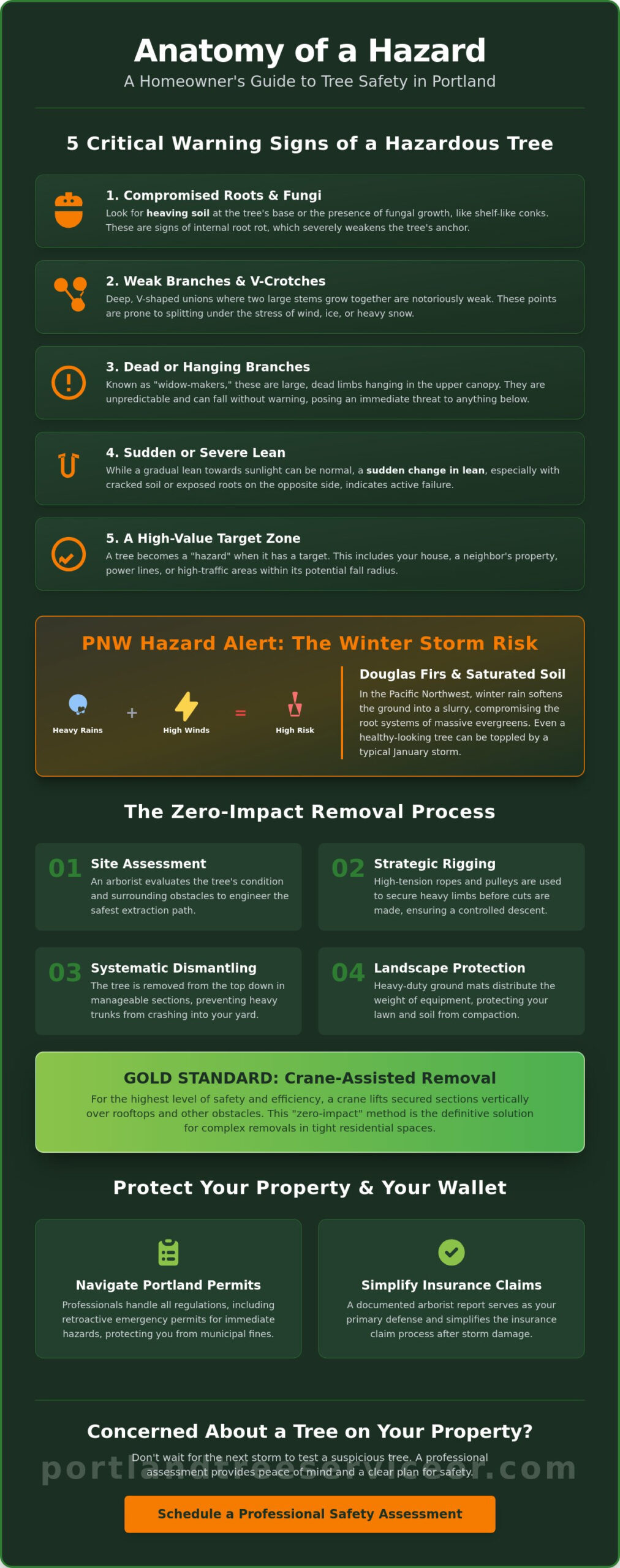
Identifying a dangerous tree requires looking beyond the leaves and examining the structural integrity of the entire organism. You should start with a visual inspection of the root flare at the base of the trunk. Look for “heaving” soil or the presence of fungal growth, such as shelf-like conks. These signs indicate internal root rot, which compromises the tree’s anchor and often makes hazardous tree removal a necessary precaution to protect your home’s foundation. When the root system fails, the tree loses its ability to withstand external pressures.
Structural defects in the canopy also signal potential failure. Deep V-shaped crotches, where two co-dominant stems grow tightly together, are notoriously weak points. These stems lack a strong bridge of wood and are prone to splitting during heavy ice or wind loads. Professionals adhere to rigorous Tree Felling Safety Standards to manage these unstable structures before they collapse. Additionally, you must watch for “widow-makers,” which are large, dead branches hanging loosely in the upper canopy. These limbs pose an immediate threat to the target zone below and can drop without warning on a perfectly calm day.
Finally, perform the “lean” test. It’s common for trees to grow at an angle to reach sunlight, which is generally safe. However, if a tree suddenly develops a lean or shows freshly exposed roots and cracked soil, it’s actively failing. This situation requires immediate attention to prevent an uncontrolled fall.
Evaluating the Target Zone on Your Property
A “target” is any structure, power line, or high-traffic area located within the tree’s potential fall radius. You should consider the entire 360-degree area around the trunk. Even if a tree leans away from your own house, it remains a hazard if it threatens a neighbor’s property or a public sidewalk. Professional assessments identify these targets to determine the safest extraction path for hazardous tree removal.
PNW Specifics: The Douglas Fir and Windstorm Risks
In Portland, heavy winter rains saturate the ground and soften the soil, which creates a specific risk for large evergreens like the Douglas Fir. When the ground becomes a slurry, the root systems of these massive trees can no longer provide adequate leverage against high winds. “In the Pacific Northwest, a tree that looks healthy in summer can become a major hazard during the high-wind saturation of a typical January storm.” This seasonal shift makes proactive inspections vital for local property owners.
The Hazardous Tree Removal Process: A Step-by-Step Safety Guide
Professional tree work is a feat of engineering that prioritizes the safety of your home and family. The process begins with a comprehensive initial site assessment. An arborist evaluates the tree’s lean, weight distribution, and surrounding obstacles to determine the safest extraction path. By following federal guidelines for Identifying a Hazardous Tree, our experts decide whether the tree can be felled in one piece or must be dismantled systematically. This planning phase ensures every movement is controlled and predictable.
Once the plan is set, the crew implements strategic rigging. This involves securing heavy limbs with high-tension ropes and pulleys before any cuts are made. We utilize the “cut and lower” method to manage the descent of each section. This technique is essential for hazardous tree removal in tight residential spaces where there is no room for error. By removing the tree from the top down in manageable sections, we eliminate the risk of massive trunks crashing into the yard. It prevents ground impact. If you’re concerned about a tree’s stability, scheduling a professional tree removal assessment is the first step toward safety.
Why Crane-Assisted Removal is the Gold Standard
In many complex scenarios, a crane tree removal service is the most effective solution for “zero-impact” extraction. Instead of dropping limbs, the crane lifts secured sections vertically over rooftops and obstacles. This method drastically reduces the time spent on-site and provides a level of safety that traditional climbing cannot match. It’s the preferred choice for large-scale hazardous tree removal where structures are directly underneath the canopy.
Protecting Your Landscape During Extraction
We take immense pride in leaving your property in better condition than we found it. Our teams use heavy-duty ground protection mats to distribute the weight of specialized loaders and equipment. This prevents soil compaction and protects your lawn from unsightly ruts. Precision work ensures that your understory plants and nearby garden beds remain untouched throughout the debris management phase. Once the sections are on the ground, we efficiently process the material into mulch or haul it away, leaving your landscape clean and secure.
Navigating Portland Regulations and Insurance for Hazard Removal
Understanding Portland’s Title 11 Tree Code is essential before starting any project. For a standard hazardous tree removal, you typically need a permit if the tree is 12 inches or greater in diameter. While most residential permits became free of charge on July 1, 2025, the application process still requires specific documentation. If a tree poses an immediate threat, you can remove it before obtaining a permit, but you must file a retroactive emergency permit within 7 days. Failing to follow these steps can result in significant fines, which sometimes reach $1,000 per inch of the tree’s diameter.
A Certified Arborist Report is your best defense against these penalties. It provides documented evidence that the tree was a legitimate hazard. Acting preventatively is almost always more cost-effective and less stressful than waiting for a failure. Proactive removal allows for scheduled work rather than the chaotic nature of an emergency response after a storm has already caused damage.
Coordinating with Insurance and Utilities
Homeowners often wonder if their policy covers the cost of removing a leaning tree. You should consult our tree removal insurance claim guide to understand how local providers handle these situations. When branches interfere with power lines, the responsibility for emergency tree limb removal often involves coordination with local utility companies to ensure the lines are de-energized and safe for work.
Getting an Accurate Hazard Assessment
There is a significant difference between a basic quote and a formal tree risk assessment. A simple estimate tells you the cost, while an assessment analyzes the probability of failure. “A professional hazard assessment in 2026 involves both visual inspection and an understanding of local soil dynamics to predict tree failure accurately.” This level of detail is necessary for high-stakes hazardous tree removal near structures. Trusting a local veteran with 30 years of experience ensures that your property remains safe and your project complies with all regional standards.
Secure Your Property Before the Next Storm
Protecting your home starts with recognizing that a tree’s health is often different from its structural stability. You’ve seen how identifying root rot and canopy defects can save your roof from a catastrophic failure. By understanding the precision involved in hazardous tree removal, you can make informed decisions that prioritize the safety of your family and neighbors. Don’t wait for a high-wind event to test the integrity of your landscape. Taking action now is the most efficient way to manage your property’s long-term health and mitigate risk.
We provide the expert guidance you need to navigate local regulations and insurance complexities with confidence. Our team offers 30 years of Portland tree care experience and utilizes specialized crane equipment for high-risk removals. We maintain full licensing, bonding, and insurance for your protection. Request a Professional Hazard Assessment from Portland Tree Service today to ensure your trees remain an asset rather than a liability. You’ll feel much better knowing your property is prepared for whatever the Pacific Northwest weather brings next.
Frequently Asked Questions
How can I tell if a tree is hazardous or just dormant?
Dormant trees possess flexible twigs and living buds while hazardous trees show signs of structural failure or significant decay. You can perform a scratch test on a small twig to look for green tissue beneath the bark. If the wood is brittle and snaps easily throughout the entire canopy, the tree is likely dead. A professional assessment identifies if the tree is a candidate for hazardous tree removal based on its structural integrity rather than just its seasonal appearance.
Does insurance cover the cost of hazardous tree removal before it falls?
Standard homeowners insurance policies generally don’t cover the cost of removing a tree before it falls. Most providers view preventative maintenance as the sole responsibility of the property owner. However, if a tree is damaged during a covered peril like a lightning strike, some policies might offer assistance for the cleanup. It’s best to review your specific coverage limits and consult with your agent before you schedule any work to understand your out-of-pocket responsibilities.
Do I need a permit to remove a dangerous tree in Portland or Lake Oswego?
Yes, you typically need a permit in Portland for any tree on private property that is 12 inches or greater in diameter. As of July 1, 2025, many of these residential permit applications are free of charge to encourage safety. Lake Oswego also maintains strict tree codes that require a specific hazard permit supported by a professional arborist’s report. We help navigate these local requirements to ensure your hazardous tree removal remains fully compliant with all municipal laws.
What happens if a hazardous tree is on the property line between two houses?
A tree located directly on a property line is considered shared property and both neighbors usually share the legal responsibility for its maintenance. You should obtain written consent from your neighbor before you proceed with any removal. If the tree is clearly dangerous, a professional hazard assessment provides the objective evidence needed to help both parties reach a fair agreement. This collaborative approach protects both properties and helps maintain neighborly relations during a stressful situation.